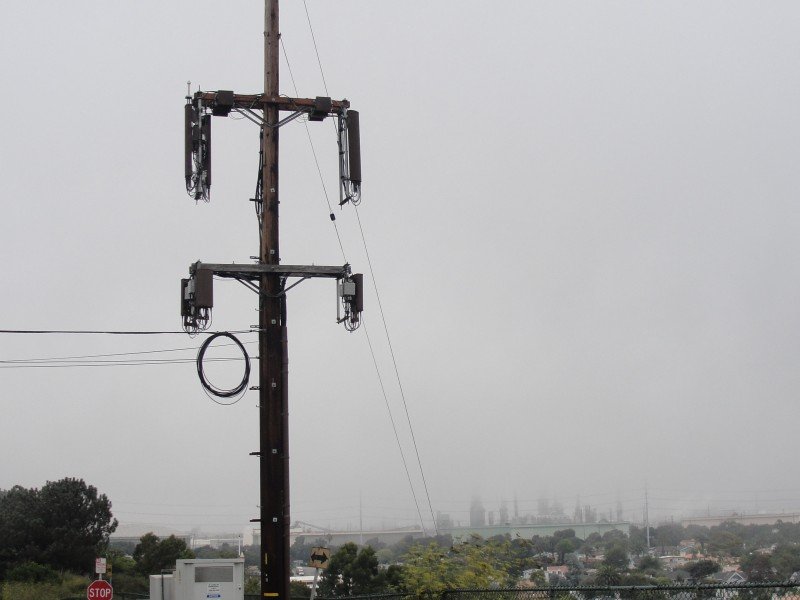
In a controversial 2-2 decision, the Hermosa Beach City Council Tuesday night rejected a plan for full deployment of a citywide wireless system that would have provided both residents and visitors with access to the Internet free of charge.
The council did, however, agree to bring the issue back in the near future if supporters of the system could secure contracts from advertisers that would cover the system’s monthly operating costs and also requested that City Manager Steve Burrell put together a report on the notion of a Wi-Fi franchise in the city. A representative from a computer technology company that wishes to bid on the project said he would ask the owner to provide the city with a lifetime warranty on parts and maintenance on the system that several of the City Council members would first like to see in writing.
“Of course the maintenance of the network is a concern because it’s an ongoing cost,” said Offir Schwartz, a sales manager with Hawthorne-based Velocity Networks Inc. “We are a South Bay company and we support this initiative. Because of that I’m going to put my neck out on the line here. I will go back to the office and see if I can convince the CEO of our company to provide the maintenance and administrative services for the network for life, at no cost.”
Any deadlocked ruling automatically fails and the missing vote that would have tipped the decision would have come from Mayor Art Yoon who excused himself from the debate due to a conflict of interest since he is an employee with Cox Communications, a firm that among other things, provides high-speed Internet service.
“Since the system has been operational, we have had 300 to 500 users on a regular basis,” said Burrell. “The system has been well-received by those who have been able to take advantage of it and probably the most asked question of staff is when will the system be deployed citywide. Overall, Phase I deployment has been a success and the things that we have learned in the past several months about the system are being integrated into the citywide deployment.”
The first phase in the project was up and running in early August following the council’s vote to move forward with the plan in late May. During this time, the City Council voted to award the city’s bid for the first phase of installation of its Wi-Fi system to L.A. Unplugged in the amount of $34,982. Tuesday night, the council also directed Burrell to come back with a report outlining options on what to do with a $75,000 donation from American Express and several people suggested that the city use this money for the project.
“I think we need to show leadership in this area and I think this is going to make your property more valuable. One of the things I promised the residents is to enhance your property value and your way of life,” said City Councilman Michael Keegan. He went on to say that a franchise agreement will not happen in a city like Hermosa Beach that provides DSL and cable services because of the competitive market factor.
Dozens of residents and business owners attended Tuesday night’s meeting to express support for the system. In fact, the only opposition that spoke publicly came from Adelphia Communications lawyer Jeremy Stern. Adelphia currently has a month-to-month franchise agreement with the city, and provides DSL and cable services to residents for a cost regulated by the U.S. government.
“I am here on behalf of my client Adelphia Communications,” he said to a crowd of “boos” and “ooohs.” “I am not here to win a popularity contest. The key point to this is that the telecommunications within the private sector of the marketplace is highly competitive and is investing billions of dollars in broadband technology. So, the critical policy issue for the city is whether municipalization of this investment is the right thing to do because in this competitive market there are risks to the taxpayers that are worth your consideration.”
At this same May meeting, the council also agreed to appropriate an added $5,000 to cover auxiliary costs of the existing budget. The vote at this time was 3-1 as Yoon once again excused himself from the discussion and Councilman Peter Tucker voted against the motion. For this vote and last night’s vote, Tucker stated that his vote against the system was mostly due in part to the cost to run it. He feels the city doesn’t have the money to spend on such a project at this time.
“I’m not against technology and I’m not against Wi-Fi or anything else,” said Tucker. “The other side of the coin is the money. Nothing is free. If I could see a revenue stream that would guarantee the monthly costs, then that would be different. The city is going to through tough economic times and I’d like to see if we could explore maybe charging $10 a month. This is going to be forever and I don’t think we have to decide this tonight.”
The city has already spent roughly $40,000 and Burrell on Tuesday night was asking that the council allocate an additional estimated $126,000 ($114,000 for work with an $11,500 contingency cost) for full deployment to be completed and operational by March 2005. Burrell added the city could make between $3,000 and $5,000 per month on revenues from advertisements. According to several residents who attended the meeting and work in the technology field, advertisements could be hard to secure beforehand when the system hasn’t been fully deployed since the desire to advertise directly hinges on the volume of users who actually access the system.
“The ongoing monthly costs for the system are estimated to total $4,500,” said Burrell. “These monthly costs are mainly for bandwidth, which will run between $2,000 for 10 megabytes (per second) and $3,500 for 45 megabytes (per second). We will start with 10 MB and move toward 45 MB once the user count is up. The installation in the citywide deployment includes the cost of bringing fiber to City Hall which will allow the use of the fiber for city operations and therefore eventually drop the separate costs we have for the two T1 lines that we have now (30 days notice for a switchover). These two lines run a total of $1,483 per month. If we allocated the same cost of the T1 lines to the monthly operating costs of the Wi-Fi system the net cost would be $3,017. Revenue from ads will further reduce the monthly costs. Other costs include system maintenance through LA Unplugged at $500 per month and $500 for hardware maintenance. The system should be useable for 10 years.”
City Councilman Sam Edgerton said he wants the city to secure enough revenues to cover the system’s operating costs before he considers voting for full deployment. Full deployment would have included 12 additional access nodes. The city anticipated that there would be between 2,000 and 4,000 users and between 50 to 250 visitors.
“I enjoy the passion and I enjoy the discussion, I think it’s terrific, but for me it always comes down to dollars and cents,” said Edgerton. “There is nothing wrong with a franchise, it’s just a way to do business. When you’re governed by Congress and you’re a regulated franchise that’s the problem, and that’s the monster we all see. Right now, Congress is not telling us how to run this deal if we do a franchise. A franchise, if we did it here, could provide services indistinguishable if the city did it by itself. ”
The first phase of the citywide plan covers 35 percent of Hermosa Beach with a point of origin located near City Hall. L.A. Unplugged placed nine access points up and down Pier Avenue so that the city’s library, City Hall and the commercial corridors along Pier Avenue will have access. Those outside the phase one area have access to the system if they have a line of sight to City Hall. This area served as a test area that gauged the system’s signal strength and the number of users registered with the system. Consultants worked through any details or bugs in this test area before installing additional signal devices in the rest of the city.
“I’ve lived in Hermosa Beach for 25 years and I’ve never seen such community action,” said resident Morty Benjamin. “The community wants this, the community is behind this. I’m all for it, I’m right in line with the antenna and it works fine. I think it’s a real community service.”
At its Jan. 13 meeting, the City Council agreed to move forward with the proposal to install the system in a series of three phases, and directed Burrell to return to the council with cost estimates related to purchase agreements and installation services.
Last July, Keegan, who spearheaded the effort, enlisted the expertise of WFI Inc., a firm that specializes in these projects, which gave a presentation to other City Council members.
“This is one of those unusual moments for the council in that you do have to use your fiduciary experience here and this transcends that. This is a visionary point that you have a chance to do something that will reflect on this city for a long, long time, long past your council terms,” said former Mayor John Bowler. “This is a laying of an infrastructure that will affect us all and particularly our children.”
The completed plan would have made Hermosa Beach one of the first Wi-Fi cities in the United States. Cerritos was one of the first cities when its City Council voted last November to move forward with a Wi-Fi project with Aiirnet Wireless. Officials of the 8.6-square-mile city will provide services to its city offices and a population of 50,000 people, but does, however, charge its residents since they do not have access to the Internet other than through a dial-up service.
The service in Hermosa Beach is free of charge to users and will provide online access to people in their homes or anywhere just as long as they possess the right devices such as an Internet slot card or a USB port antenna. Users will be able to access the signal just like they access an FM/AM radio signal. They will be able to pick up reception within about a half-mile radius. The entire city of Hermosa Beach is about 1.3 square miles with a population of about 20,000.
Aside from the installation, the city would pay for maintenance fees and the necessary amount of bandwidth, which is the amount of resources needed for users to log onto the Web for various Internet activities (e-mail is a low-intense use while downloading music is a high-intense use). The new service would be equivalent to a high-speed DSL connection. The city would offer the services to not only residents and businesses, but visitors as well, through third-party contracts.
The city has provided residents and visitors with a link (www.wifihermosabeach.com) on its Web site (www.hermosabch.org) where users can click and discuss issues related to the system in a public forum.
One of the biggest problems has less to do with the system and more with a frustration in having to buy additional equipment to access the antenna and log on to the system.
With any new technologically advanced system offered to the public, there have been problems experienced in the form of choppy signals or problems with connection. The city has made an effort to remedy such obstacles by hosting evening informational workshops at City Hall where anyone wishing to log onto the system can learn how to do it and what kind of equipment is needed.
 The Lazy Sway