By Whitney Youngs
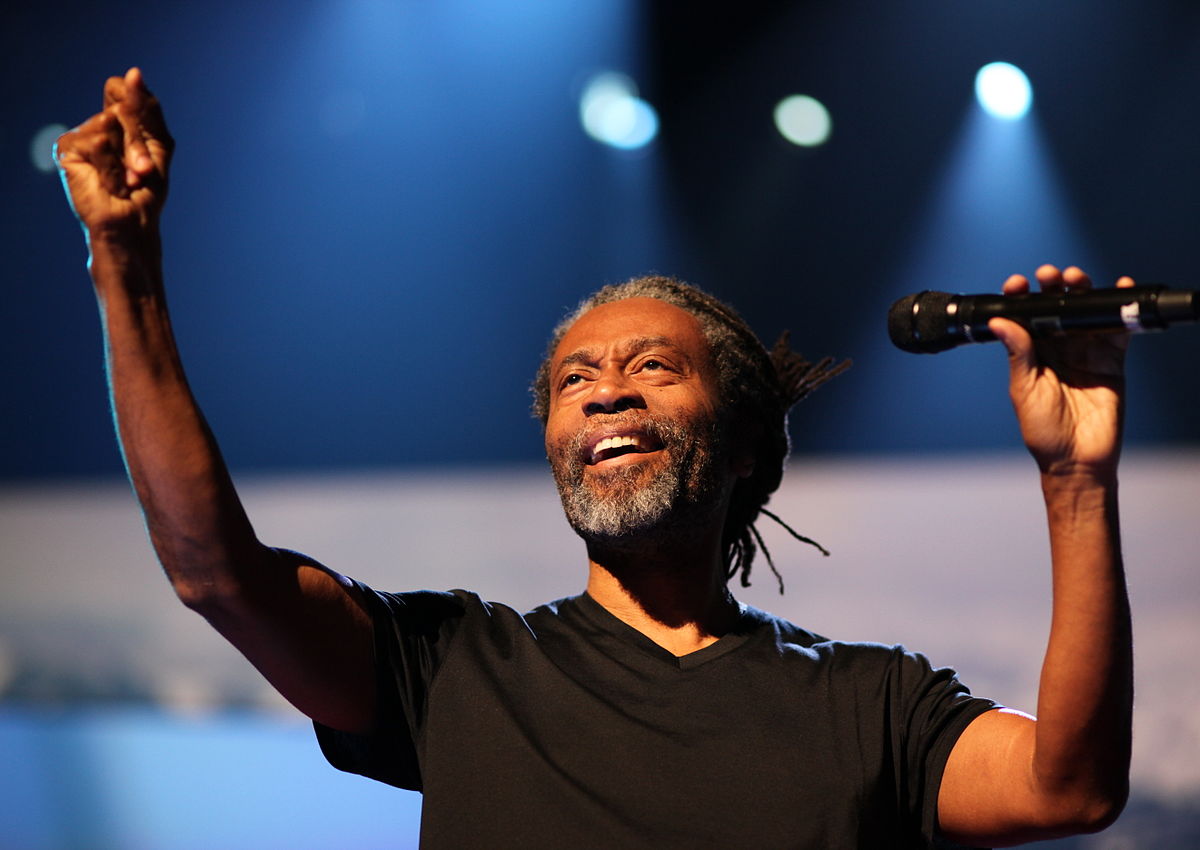
“We walk out on stage and just start to improvise, nothing is preplanned or thought out beforehand, not a single note – everything that you see on stage is happening at that moment,” said vocal virtuoso Bobby McFerrin about his shows, collaborating with the 12-member ensemble Voicestra. The act is performing at the California Center for the Arts, Escondido, Jan. 28.
“This is a pretty rare group, I don’t know of any other professional groups that improvise a full evening of music, which is rare in today’s musical climate: a group that is willing to do that, in front of people,” said McFerrin.
Voicestra is best described as a collection of superb singers whose tastes and fortes range from R&B, jazz, classical to opera, Indian and Middle Eastern music. Founded by McFerrin in 1986, Voicestra is more than an interactive choir; it is a spiritual and human instrument networking with the breathtaking voice that is McFerrin’s.
“I must say, probably more than anything I do, I enjoy working with this vocal group the most, and I think it’s basically because I am surrounded by very dear friends, some of whom I have been working with for as long as 26 years,” said McFerrin. “It’s such a wonderful community of people, creatively and spiritually, I probably enjoy it the most because I have all these wonderful resources to draw from – they are all excellent improvisers.”
With his four-octave voice range, McFerrin has the capacity to sing in the style of virtually any genre, from jazz and classical to folk, world music, choral and cappella, and, because of that, has worked with the likes of cellist Yo-Yo Ma and jazz pianists Chick Corea and Herbie Hancock. He has also teamed up with the Vienna Philharmonic, as McFerrin is also known for his work in the field of classical conducting.
Over his career, McFerrin has won 10 Grammy Awards and is famous among pop music listeners for the song “Don’t Worry, Be Happy.” He was born in 1950 in New York City to opera singers. His father, McFerrin Sr., was the first African-American male soloist with the Metropolitan Opera. The family moved to Hollywood in 1958 when movie executives hired McFerrin Sr. to sing the parts of the character Porgy, played by Sidney Poitier in the film “Porgy and Bess.”
McFerrin’s first experience as a musician came in the form of the clarinet, but when he got braces he switched over to the piano. At one point in his life, McFerrin contemplated the priesthood but his love of music won out in the end. He formed the Bobby Mack Quartet in high school and toured the country with the Ice Follies and also worked as a pianist in a lounge band.
“I have two dreams I would love to fulfill before I die,” said McFerrin on his two ideal music projects. “One is to put together a band with James Taylor, Allison Krauss, Eric Clapton, Edgar Meyer and Steve Gadd. And the other is to conduct the Vienna Philharmonic at Carnegie Hall.”
It was in 1977 that McFerrin tested the waters in the area of singing and a year later joined an ensemble known as the Astral Project based in New Orleans. With his manager, Linda Goldstein, who went from singer to music entrepreneur, McFerrin developed an entirely improvised vocal concert inspired by the performances of pianist Keith Jarrett whose most well-known example of such virtuosity is the 1975 show put to record, titled “The Köln Concert.”
“In the very beginning, when I discovered my voice, I practiced at least two hours a day for two years without listening to singers,” recalled McFerrin. “I wanted to know what I sounded like and what my technique was going to be because I didn’t want to borrow techniques from other people. It’s interesting because as a conductor I tried on different people’s techniques to see what it felt like, but I didn’t do that as a singer because I was concerned that I might find myself singing in a way that wasn’t healthy for me. I would listen to instrumentalists but no singers, not for a couple of years.”
In 1980, McFerrin appeared at the Playboy Jazz Festival, thanks to comedian Bill Cosby, and soon after released his first album. In 1983, his dream of making a living at improvised vocal concerts had become a reality as McFerrin embarked on his first European tour as a solo singer. McFerrin, with the Manhattan Transfer, won his first Grammy in 1985 for the album “Another Night in Tunisia,” and by 1988 had established himself as an improvised vocal soloist, playing in premiere venues in Europe and Asia, as well as the Hollywood Bowl and Carnegie Hall in the U.S. McFerrin later recorded “Simple Pleasures” – its theme a tribute to the music of the 1960s. The famed song, “Don’t Worry, Be Happy,” which he wrote on the spot in the studio, was nominated for Album of the Year and won both Song of the Year and Record of the Year at the 1988 Grammy Awards. At the height of his mainstream music popularity, McFerrin went on sabbatical and began his serious study of conducting classical music, taking lessons from the likes of Leonard Bernstein, Gustav Meier and Seiji Ozawa.
“The one thing that I’ve learned as a sort of – and I hate the word – celebrity (it was around the time ‘Don’t Worry…” was flying out the door and when I was a jazz musician so I have had these degrees of fame) — is that [celebrity] doesn’t matter [in the long run], what matters is longevity. I am just very grateful that I am still working and that I can support my family,” said McFerrin. “The sabbaticals have helped me to remember, being here with my daughter, my wife, walking my dogs, living out in the woods, appreciating nature, writing music, that these are the important parts of life. Being on stage is not important in the scheme of things. It’s wonderful to entertain people, to share joy because I think my job is to bring joy to people through singing and that part is important, but being in the press, noticed, being a celebrity, all those things are way down on the scale of things.”
On his 40th birthday in 1990, McFerrin conducted the San Francisco Symphony Orchestra and then recorded “Hush” with Ma. Since then, McFerrin has conducted a handful of orchestras such as the Chicago Symphony Orchestra, the New York Philharmonic and, most recently, the Vienna Philharmonic during its 2003 tour.
 The Lazy Sway