By Whitney Youngs
Comedian Bob Newhart is what you would call modern. Modern in the same way as Mark Twain or Willie Nelson – his material is still hip, and because it is, he is beloved by a cross-pollination of people from a sundry of generations.
For fans living in San Diego, their chance to see the man who adapted a not-so-average, one-sided conversation over the telephone into a sidesplitting art form is just around the corner, as Newhart will perform at the California Center for the Arts, Escondido on Jan. 13 in a matinee and evening performance. Singer Susan Egan will open the shows at 2 and 8 p.m.
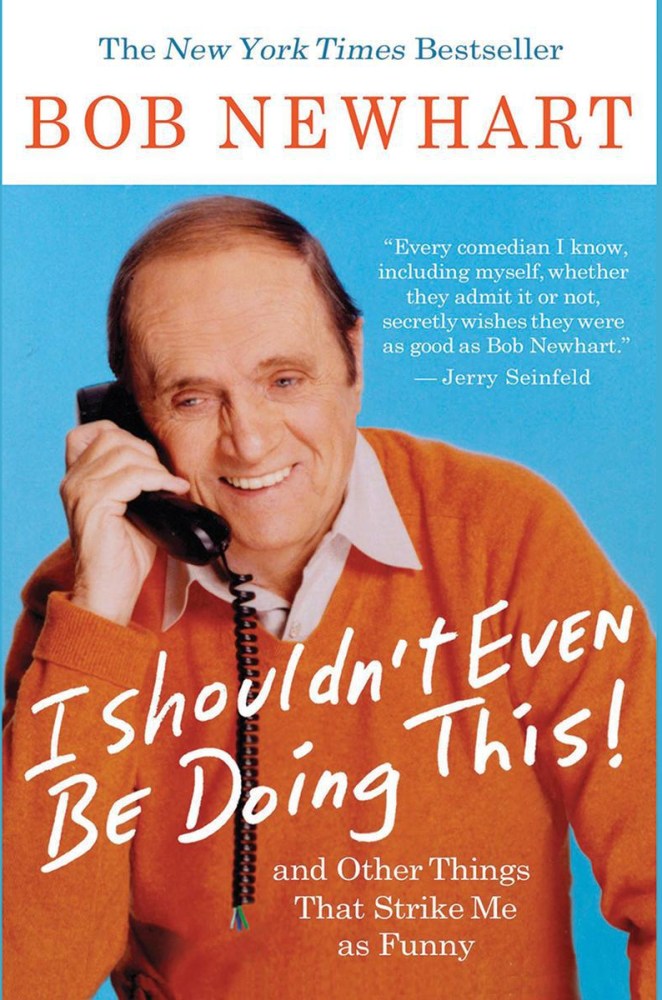
Newhart is also the author of a book – his memoir of sorts – released in the fall, titled, “I Shouldn’t Even Be Doing This! And Other Things That Strike Me as Funny.”
“I don’t know what to call it, I think memoirs are for geishas and the Marquis de Sade, I don’t know,” said Newhart this week over the phone about how to classify his book. “[A memoir]… it sounds kind of ostentatious.”
The book chronicles Newhart’s childhood, his observations on the nature of all comedians, the success of his two albums, “The Button-Down Mind of Bob Newhart” and the “Button-Down Mind Strikes Back,” tanking on stage and meeting his wife of 43 years, among other things. But as Newhart writes, “…I’m getting a little bit ahead of myself.”
Born in 1929, Newhart grew up on the west side of Chicago – a geographical segment of town that afforded him the choice of either being a Cubs or White Sox fan – as the second of four children and the only boy. Raised Catholic, Newhart took a 45-minute streetcar each day to attend St. Ignatius High School even though he lived only eight blocks away from the public Fenwick High School.
“When I was in high school, I worked as an office boy, (I don’t even know if they even exist anymore: office boys), but I had this long ride from downtown Chicago out to where I lived, and I became a huge fan of Sir Arthur Conan Doyle. I read every Sherlock Holmes book I could get my hands on, and later in life realized that what mystery writers do and what comedians do – it’s kind of the same thing,” said Newhart. “A good mystery writer is going to disguise who the killer is until the very end and you’re going to suspect everyone but [the killer], otherwise you’re not a very good mystery writer if the reader knows two pages in. And that’s kind of what comedians do, when we tell a joke, we kind of disguise the punch line until the very last minute.”
Newhart graduated from Loyola University with a bachelor’s degree in business management and later enrolled in the university’s law school. He left the halls of academia a year and a half later without a law degree, citing that trying to juggle part-time work as a law clerk, his studies and performing at night with a local theatre troupe, the Oak Park Players, was too much. In the early 1950s, Newhart was drafted into the army and later worked in the real world in the field of accounting in Chicago. He then took on part-time jobs as a way to try his hand at comedy to see if he could actually make a living at it.
“People ask me, ‘How do you keep from breaking up?’ And it’s just my natural way of being, my natural reaction to the world,” said Newhart when asked about his relaxed knack for deadpan humor.
In 1958, Newhart got a job appearing in a segment called “Man In the Street” broadcast on the local WBKB, an ABC affiliate in Chicago. He was making $300 a week and finished work each day by 10 a.m. He took the bus home to retrieve his golf clubs and made it to the course for the first tee by noon. Newhart’s first album came to fruition when a friend gave some of his early radio tapes to George Avakian with Warner Bros. Records. Avakian wanted to make an album and told Newhart the next time he was playing in front of a live audience he would send out a team of engineers to record the session. At that time, Newhart had never performed in a nightclub.
“I would say the first two or three years were kind of bravado, I kind of acted like I knew what I was doing,” said Newhart on doing stand-up following the success of his two albums. “The first thing you learn in stand-up is that you can’t show fear. So, for years, my career was backwards, I had to learn my craft as I was doing it. But that’s they way it was, and I am glad that it happened that way.”
In February 1960, “The Button-Down Mind” was recorded at the Tidelands Motor Inn in Houston. It shot up to No. 1 on the Billboard chart, and the next thing Newhart knew, Warner Bros. wanted to record a sequel that became “The Button-Down Mind Strikes Back,” which rose to No. 2. Newhart won Best New Artist of the Year, Best Comedy Performance (“The Button-Down Minds Strikes Back”) and Album of the Year (“The Button-Down Mind”), beating out Frank Sinatra in the latter category at the 1961 Grammy Awards. The albums stayed at No. 1 and No. 2 for two consecutive weeks. Newhart met his wife, Virginia Quinn, and they married in January 1963. The couple has four kids and seven grandchildren. Newhart, who was once an avid golfer, doesn’t play as often these days because of his bad back.
“I am hoping that it is going to get cleared up, I am going to therapy because I would hate to think I would never play golf again because I love it, I love the sport,” said Newhart. “The last time I played was in Del Mar, as a matter of fact, which was beautiful. I played with a couple of jockeys from Del Mar who I have gotten to know, and that was a kick.”
Following the success of his albums, Newhart hosted his own variety show for a year, “The Bob Newhart Show” in the early 1960s. Newhart also starred in the 1962 film “Hell is for Heroes” and several other films in both the 1960s and 1970s, such as “Catch-22,” “Hot Millions” and “First Family.”
Newhart became a television icon in the 1970s with his hit TV show “The Bob Newhart Show,” which ran from 1972-1978 (and was rerun in syndication). The sitcom was set in Chicago, but recorded in Los Angeles, in which Newhart played Dr. Robert Hartley, a psychologist, and Suzanne Pleshette played Hartley’s wife, Emily. It is rumored that the drinking game, “Hi Bob!”, came out of the show’s reruns and may have originated at Southern Methodist University in Dallas. Participants gather around the tube and every time the phrase “Hi Bob!” is said everyone takes a swig off their favorite alcoholic drink.
In 1982, “Newhart” made it to the airwaves in which Newhart played Dick Loudon, the keeper of Stratford Inn in Vermont (also recorded in Los Angeles). The idea for the ending of the famous finale in which Newhart playing Hartley wakes up in bed, lying next to Pleshette as Emily, and tells her about a weird dream he had in which he owned a New England inn, came from Newhart’s “real life” wife, Ginny. In order to keep the surprise ending under wraps, the writers of “Newhart,” who drafted the last episode, also created a fake finale and script in which Loudon is hit by a golf ball and dies and meets God played by George Burns. More than 30 million viewers tuned in to watch the secret finale and TV Guide later named it as one of the five most memorable moments in television history.
In the early and mid-1990s, Newhart returned to television with “Bob” and later “George & Leo,” starring opposite Judd Hirsch (“Taxi”). Newhart continued to work in film, taking on supporting roles in hits such as “In & Out,” “Legally Blonde 2: Red, White and Blue” and “Elf.”
For those wondering if Newhart’s trademark stammer is part of the act, the answer is no. It is really the way he speaks both on and off stage. In fact, while working on his first sitcom, “The Bob Newhart Show,” one of the producers informed him the show was running a little too long and asked if Newhart could cut time off his lines by nixing the stammering and Newhart said, “No. That stammer bought me a house in Beverly Hills.”
“It’s my natural way of talking and in comedy it helps,” said Newhart.
In the introduction of his book, Don’t Judge My Book By Its Title, Newhart writes about the title’s origin. His editor told him that titles sell books and with that piece of advice, Newhart proposed A Slimmer You in Three Weeks and later Finding Mr. Right, but the publishing house’s lawyers nixed both. Several more titles were thrown around (my two personal favorites: The Fat Lady in the Pink Dress Wants a White Wine and What Does God Want With a Dead Dog) before everyone settled on I Shouldn’t Even Be Doing This!
“I like The Fat Lady in the Pink Dress Wants a White Wine, because it kind of sums up with comedians there is a part us that still remain as children, we still say things like that, somehow civility isn’t beaten into us and we sort of say we think,” said Newhart.
Newhart also dedicates one chapter to the perspective of comedians in how they view life differently from the average person – they are the constant observers. Newhart also writes about their temperament, describing them as sadistic, self-absorbed, possessing multiple personalities and a perverse sense of humor. He also mentions some can’t tell a joke and they are also thin-skinned. Newhart does write, however, that ventriloquists are a breed of their own, and tells the story of Pat Patrick, who committed suicide by jumping from an airplane. His suicide not read, “The dummy pushed me.”
“People don’t believe it, but Dick [Martin, who told Newhart the story] doesn’t make things up, he knew Pat,” said Newhart. “I guess it was a private plane he was in, and he jumped out and left a note. Ventriloquists and impressionists, they are the weird people in our business because they don’t know who they are. I am not sure comedians know who they are, but somewhere in the act the ventriloquist has to remind the audience they are controlling the situation. There is kind of a strange relationship with the dummy and the ventriloquist.”
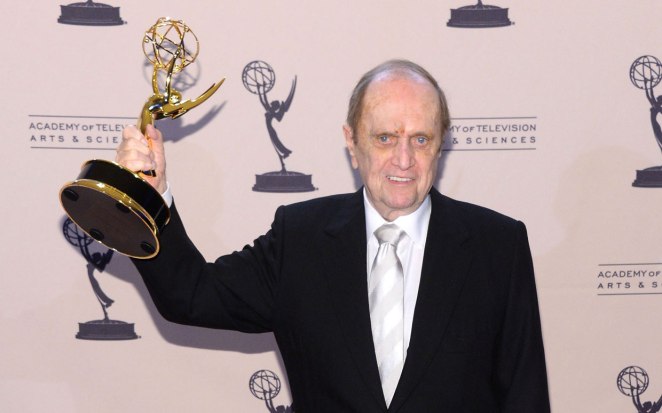
In the last several chapters featured in the book, Newhart writes about the science of humor, his aversion to flying, his love for golf, famous people he has met (including his close friend Don Rickles), being mistaken for actor Paul Newman and people he wishes he’d known. Newhart hosted the “Tonight Show” with Johnny Carson a record 87 times, won an Emmy and a Peabody Award for his work on the “Bob Newhart Variety Show” and has acted in 14 feature films. In 2002, the Kennedy Center awarded Newhart with the Mark Twain Prize for American Humor. And just like Twain, Newhart is modern.
Newhart will perform at the California Center for the Arts on Saturday, Jan. 13. For more information, visit http://www.artcenter.org.
 The Lazy Sway