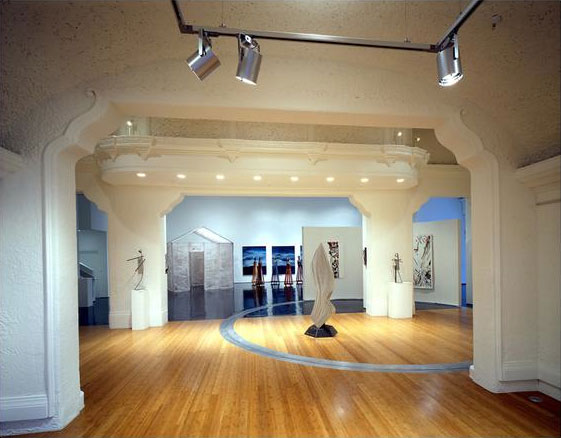
Although they have lived in the South Bay for years now, Palos Verdes resident Jason Moskowitz and Hermosa Beach resident Michael Napoliello first garnered local mainstream attention in the community with the grand opening of their new art gallery occupying the largest portion of the historic downtown Bijou Theater on Hermosa Avenue.
The two business partners, who are the Bijou’s anchor tenant, opened Gallery C in June 2003 in the landmark building erected in 1923 which was renovated in 1999. Since the gallery’s opening, Moskowitz and Napoliello have exhibited the work of both well-known local and nationally recognized artists from all over California.
Since then, the duo recently finished work on a book entitled “Spark: Lending Your Way to Real Estate Millions” that is now out on the market. In the book, Napoliello and Moskowitz, founders of the Torrance-based U.S. Marketing & Promotions, share their advice on how the public can gain access into the world of real estate lending through the latest financial innovation called orchestra funding.
The men, who have known each other since their high school days in New Jersey, know a thing or two about private business as owners of their marketing firm that was named No. 107 out of the nation’s fastest growing private companies by the magazine Inc. They have since sold the company to Omnicom Group Inc. and recently founded orchestrafunding.com. They are also executive officers of InSymphony Private Capital. Napoliello is no stranger to working on side projects. As the owner of U.S. Marketing and Promotions, he still managed to write six books and record three music albums.
The Beach Reporter this week sat down with Napoliello, who is acting as the book’s official spokesman, and talked about its content and the notion of orchestra funding.
The Beach Reporter: What inspired you and your business partner, Jason, to write such a book?
Napoliello: I think I have a passion for the business and it’s unusual for a new investment vehicle to be introduced to the world. It’s one that specifically has been an area of business that hasn’t been participated in by sophisticated investors in the general sense as opposed to something that most people are familiar with like mutual funds or stocks or CDs. Jason and I have been developing this for a number of years and benefiting from it. We felt that we were involved in something historic and it would help this industry grow. We were at the point of practicing what we had been preaching for a number of years, and we felt like it was an opportune time to put this book out and let people know what we had concocted.
How long did it take to complete the book?
It took about six months. It is a small book but there is a lot of information about an industry that really hasn’t been written about much. People would say that there are thousands of books on how to make money in real estate. They are all about how to make money buying real estate. There are almost no books that I could reference on the business of loaning money to enable people to benefit in the world of real estate. If you talk to a lay person, many would say that such a business is reserved only for banks and loan sharks. There is a sort of third world of lending and has been up to this point a very lucrative industry but a very insular world.
What is the main theme or purpose of the book?
We wanted to say that the public can participate in this business as well. Maybe it’s a little premature right now but if you read this book at least you’ll know what changes are coming and what new financial vehicles are on the horizon. You may, depending on your bank account, be able to participate directly in this industry and this book will be a good first step. It’s not an encyclopedia by any means but it’s a nice primer, an eye-opener.
Do you feel that lending is more lucrative than buying?
Generally speaking, lending on the initial level will be more lucrative and profitable perhaps by 20 percent. What’s interesting about it is that a lot of people don’t realize that the money that is being lent to spark a project also has collateral similar to a bank mortgage, whether it’s the property or the plans or the idea. So, relatively speaking, I think it’s less risky than ownership. A borrower is obligated to pay back a loan by a certain time and if you own a building or a house there is no saying when someone is actually going to come up with the purchase. With lending, you take out that time factor and it’s obviously a more liquid business since when you own a house you have to sell it in order to get the money for it. When you have a loan, it’s due on a particular day. Lastly, someone else does all of the work. The lender has to assess the project and the people involved, and oftentimes these projects have 100 percent or more of collateral, so in a lot of ways you’re getting a better rate of return than the owners with less risk.
In your opinion, what kind of future does this business have?
Well, people hear about this and think that it sounds really good, and that’s why it sounds almost too good to be true. But I always remind people that there was a time when mutual funds were brand new, there was a time when the stock market and life insurance were all new. They were financial vehicles that, at one time, were invented by someone or some organization and for a long time people thought it sounded risky or too good to be true. I think this industry will be looked back on as being really innovative and groundbreaking because I’d say five to 10 years from now, this will be a common thing in people’s portfolios. Instead of owning their own property they are going to own what someone else owns.
Does this book target a specific audience?
I think the audience is what I call sophisticated investors. People who have portfolios, who are in charge of their family’s money or well-to-do people who like to be in the know about developments in the investment and wealth-protecting side of the world. Another important group is the real estate and banking firms along with investment professionals who are the gatekeepers for their various customers – investors, developers, etc. I think the book will have an appeal to wealthy people who really are trying to keep up with all the opportunities. I would like to see as my legacy that there would be hundreds of funds that started an orchestra-funding boom and there would be many funds where you could safely invest your money, and know that these companies are benefiting from high rates and return and low risk.
How do you go about getting involved in this business?
Well, there are two ways to get involved. One is to become a lender and we talk a little bit about it in the book. You are not going to read the book and start a business like this but you may have never heard of this business and you can now begin to do further research and begin to develop a small project on your own. The other way would be to look at the Orchestra Quarterly Income Fund LLC, which is the first of its kind. The problem with that is that the entry level to a fund like that now is generally in the six figures and to wealthy people that is fairly reasonable, but to the typical investor that may be too many eggs in one basket. But as a demand grows for this type of product, it will enable companies like ours to reduce overhead, increase efficiency and our returns such that we would be able to manage a greater number of investors with a smaller initial investment. We are hoping one day that we will be able to offer a low point of entry to a typical investor for around $1,000. That day is not here yet and so why read the book? But I say that it’s good to know what’s coming.
For those who wish to purchase the book, they may visit Internet retailers like www .amazon.com or www.barnesandnoble.com. Those who wish to learn more about Moskowitz and Napoliello’s business endeavors may visit www.insymphony.us and www.orchestrafunding.com.
 The Lazy Sway