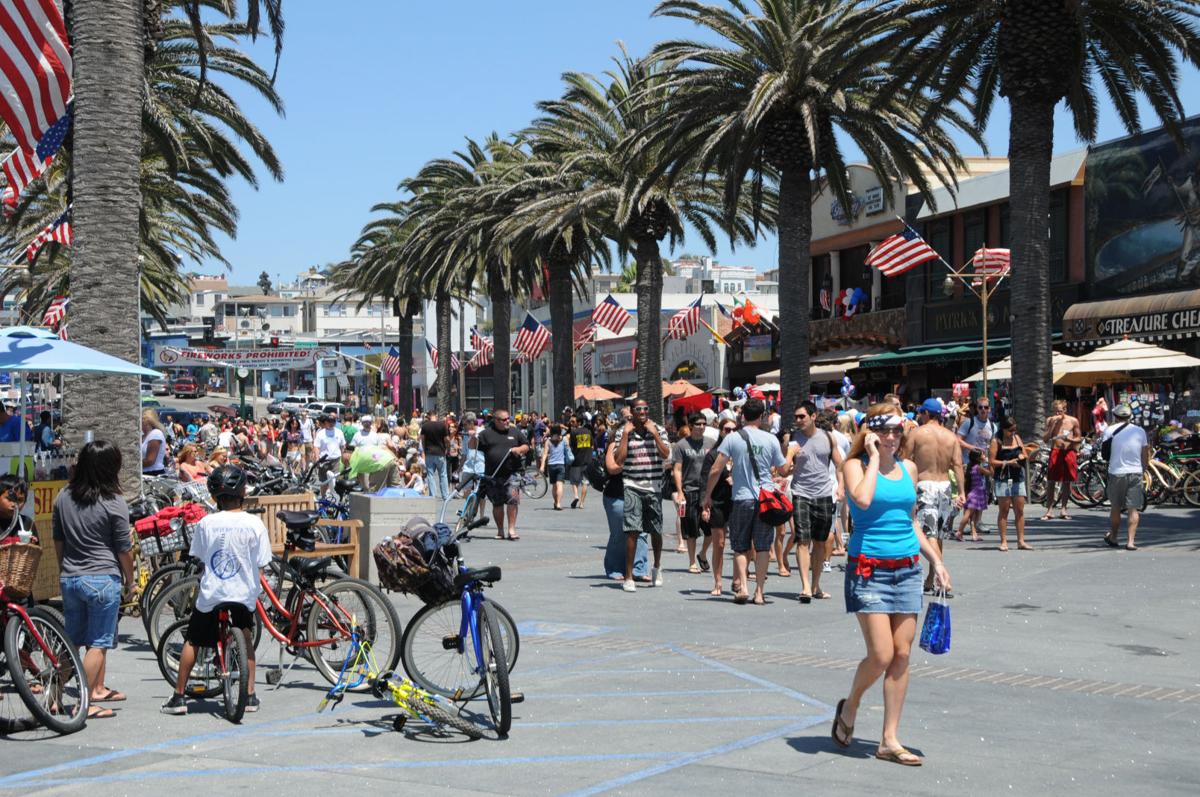
In a public meeting, Hermosa Beach residents and business owners along with a few elected city officials and employees Aug. 4 discussed several ongoing issues that just don’t ever seem to go away pertaining to the city’s raucous nightlife in the downtown area and on the pier plaza.
City officials fielded numerous complaints from residents who live in the nearby neighborhoods who are sick and tired of waking up in the middle of the night to drunken party animals, some of whom yell and scream down residential streets, urinate in front yards or vandalize private property.
Police Chief Mike Lavin commented on the present environment spanning roughly the past six months, and said that there have been no major incidents and the area overall has improved.
Newly appointed Planning Commissioner and lifetime resident Rick Koenig attended the meeting and said most of the issues discussed centered on a “fraternitylike atmosphere” in the downtown in which a handful of police officers are regulating a scene comprising hundreds of restaurant and bar patrons.
“I know a lot of people are fed up with the ‘red cup syndrome’ where people are walking around in public drinking openly,” said Koenig, “and the urination and trash in everyone’s yard, including mine. These kind of meetings are good in the sense that at least it allows people to vent instead of building up animosity and so it’s a step in the right direction.”
The public meeting, which began as proactive but eventually turned into a rather heated debate, provided residents with an opportunity to verbalize their frustrations and concerns about a downtown that attracts throngs of young people, both local and from out of town, most every weekend and on some weeknights.
“I think these problems can be fixed. We just need some positive solutions because if all we do is antagonize each other then that’s all we’ve done,” said City Councilman J.R. Reviczky. “Unfortunately, if you get 10 people in a room, one of them is going to be an idiot; with 100, 10 are going to be; and with 1,000, you have 100. That’s really what the scenario is down there and anywhere. Half of the laws that are passed by government are passed because 10 percent of people have no respect for others. You have a lot of people down there and you have a lot of people down there spending money, you’re going to have that 10-percent figure no matter what. That ratio stays the same and we’ll always have to deal with that 10 percent.
“We used to staff officers that were on overtime and now we actually have a special shift down there which helps with overtime costs and gives those officers a better grasp of what is going on when you have the same people down there all the time. You have to give that a chance to work and I think that is the phase we are in right now.”
The meeting also served as a platform in brainstorming solutions to such problems, which have been at the forefront in the city for years now.
Planning Commissioner Sam Perotti also attended the meeting and suggested that at the next session an agenda be drafted as a way of providing a bit more structure.
“I think there needs to be continued coordination between the business operators, and the Police and Fire departments. I think that in the long run, things will work out,” he said. “In the past, the Planning Commission has modified business conditional use permits by limiting hours mainly based on excessive noise and that has been an effective resource.”
Resident Al Benson has been a strong proponent of cracking down on bars and restaurants that become nightclubs in the evening that he believes serve as a breeding ground for much of the boisterous behavior of patrons.
“Of all the things that are going on down there, there are monetary costs – cleaning the plaza, police overtime – and then there are human costs, people are getting hurt and I’m tired of reading in the newspapers of police being attacked as well. All these costs, are they worth it?” said Benson. “It seems like even with implementing some solutions – like reducing noise and occupancy, enforcing underage drinking – but the number of people who come down there does not change and the age group does not change and the amount of alcohol really does not change, we won’t have a real effect on alcohol-related crimes.”
According to the city’s quarterly statistical reports for 2003, the Police Department cited the largest number of adults arrested in more than a decade.
According to the report, robbery stayed the same with 13 cases reported in 2002 and 2003. Both assaults and burglaries increased this year compared to 2002 with 140 reported assaults and 143 burglaries compared to 131 assaults and 118 burglaries reported in 2002. The number of reported D.U.I. arrests rose with 214 cases reported in 2002 and 285 cases reported in 2003.
Police transported more people to jail in 2003 with 1,012 adult arrests in 2002 and 1,315 adult arrests in 2003. The number of police calls for service increased this year from 28,728 to 32,241 while the number of disturbance calls dropped from 3,343 to 2,788.
In mid-February, the Planning Commission unanimously voted to review conditional use permits of Aloha Sharkeez and Sangria.
“The thing that I don’t think people really understand is that the downtown area in the overall picture in terms of parking, taxes, licenses is about $5 million to the city and people tend to forget what it was like 10 years ago,” said Sharkeez owner Ron Newman. “For the amount of people who come down, it’s pretty well-run. Most of the businesses are upscale and sell food, and it’s not going to go away. The people who have businesses have a right to be here. If there are problems, then those problems need to be solved between the individual and the business, and it has to be solved realistically. Hermosa is what it is and without these businesses Hermosa wouldn’t be able to survive. I think there should be a city liaison that someone could go to, and that person could meet with both the business and the citizen because if you don’t try and solve these problems, no one is going to win.”
At its February meeting, the commission reviewed an incident report drafted by Lavin that details the history of officer calls responding to incidents taking place inside or outside downtown restaurants and bars, and several along Pacific Coast Highway.
“For the past several years, the city of Hermosa Beach has enjoyed a very popular downtown area,” stated Lavin in his report. “In particular, the Hermosa night life has become very popular and several thousand patrons frequent the downtown nightclubs especially on the weekend nights. The Police Department has had to increase the amount of enforcement activity on the Hermosa plaza to keep a lid on the crowds and the associated public disturbances, assaults and public intoxication that have become very commonplace each evening between the hours of 10 p.m. and 2:30 a.m.”
The Police Department staffs the plaza with foot patrol units on every night of the week with the exception of Monday and designates additional foot patrols on weekend nights.
“All of this activity is paid through overtime and is costing the city several hundreds of thousands of dollars each year,” added Lavin. “This activity on the plaza has also been the source of numerous personnel complaints against officers, claims against the city, lawsuits and injuries to officers.”
According to Lavin’s report, officers received 83 and 71 disturbance calls from Sangria and Aloha Sharkeez, respectively. The report tracks the history of calls from Dec. 1, 2002, to Jan. 10, 2004. Lavin also wanted to make it clear that such number of calls were made in front of an establishment, not necessarily inside of them.
Because the two establishments ranked as the first and second in the highest number of calls among the 15 other restaurants and bars mostly located in downtown and some along PCH, Lavin asked the commission to review both CUPs. The commission will determine whether the CUPs were properly and adequately implemented as a way of controlling some of the problems that have come in the form of such disturbance calls.
Among the restaurants with the lowest number of calls, Patrick Malloy’s was ranked the lowest with one call followed by the Poop Deck with two calls, the Hermosa Yacht Club and Caf/ Boogaloo with three calls, and the Mermaid restaurant and Barnacles tied for fourth place with five calls each. The report focuses on calls directly dealing with disturbances, assaults and public intoxication.
Of the remaining establishments, Shark’s Cove received six calls, followed by Pointe 705 with 10, Hennessey’s with 11, TJ Charly’z and the North End Bar with 13, Hermosa Saloon with 16, the Pitcher House with 17, the Underground with 33 and the Lighthouse with 45.
Carla Merriman, executive director of the Chamber of Commerce, commented on the “red cup” drinking scene and expressed satisfaction in knowing that the bars have begun to take initiative in recent months.
“It was good to hear that the bars are cleaning up their act,” she said. “I think that more information should be given to residents regarding the value of these businesses on the plaza – Sangria, Sharkeez and Hennessey’s are consistently among the top 25 sales tax producers. When I hear residents talking about people on The Strand with red cups and blaming the establishments for that, I think it’s ridiculous. The restaurants and bars do not pour drinks to go. I think we need to work in the community as a whole and whatever the chamber can do to help, we would like to as a way to move in a more positive direction.”
 The Lazy Sway