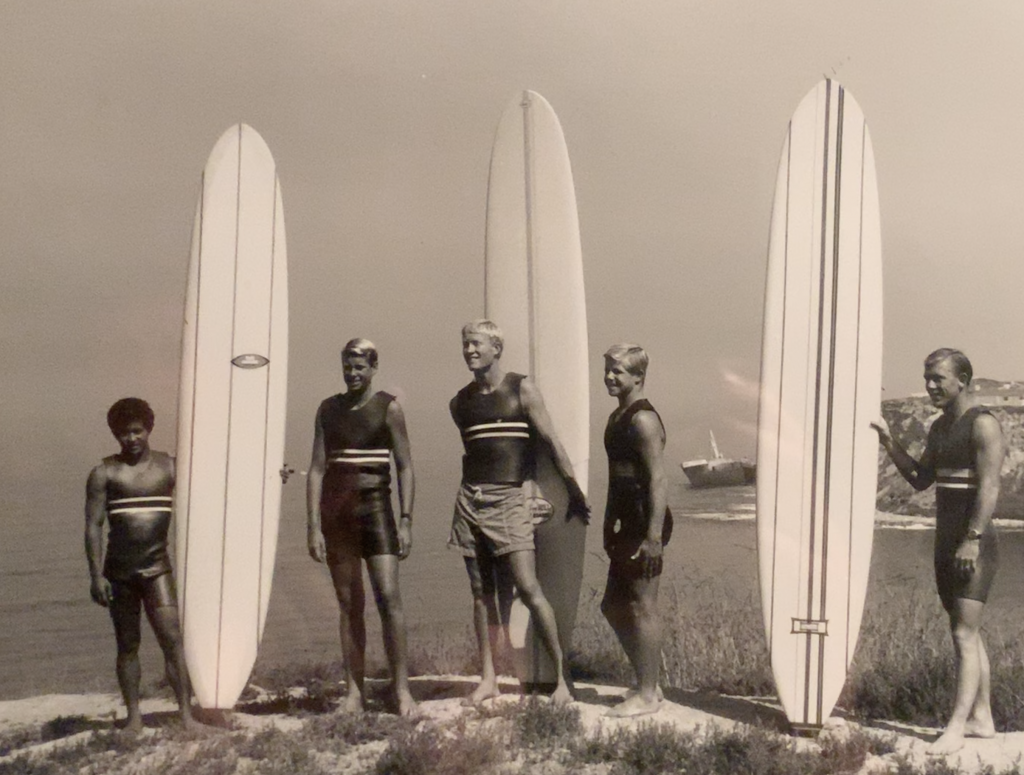
As a way of celebrating its 20 years of service to the preservation of coastlines all around the world, the Surfrider Foundation has enlisted the talent of 30 surfboard shapers, among them two famed surfers from Hermosa Beach, who recently made one-of-a-kind boards for a high-profile fund-raiser this month.
A portion of the collection of boards were on display this past week at the foundation’s South Bay chapter local fund-raising event where former world champion surfer and chair of the foundation’s advisory board, Shaun Tomson, was a special guest.
The collection of surfboards will be auctioned off at the Sony Pictures studios in Culver City June 17.
“The money will go toward the Surfrider’s national body which is essentially a group of about 40,000 environmentalist surfing enthusiasts around the country that are tied together in local chapters,” said Tomson. “It’s difficult to estimate how much we hope to make but I think the collection of boards is certainly worth $100,000 to $200,000. It’s certainly the greatest collection of boards ever manufactured for a specific event. It’s never been done before in the history of the sport; that such a diverse collection has been made for one event. It’s a very unique collection and it certainly represents the evolution of surfboard designs over the last 40 or 50 years. It’s very representative of the most influential boards that have been created. They are all hand-shaped and all handmade, and so each board in and of itself is a work of art representing a particular era and particular moment in the evolution of surfing.”
A group of four men – Chris Evans, the United States executive director of Surfrider; Tomson; and two other foundation advisory board members – selected the shapers who have designed board shapes popular among surfers. Legendary shapers like Dale Velzy, Greg Noll, George Downing, Gerry Lopez and Hobie Alter crafted the custom-made boards that feature the foundation’s 20th anniversary logo and its maker’s signature. The world-renowned auction house, Sotheby’s, will host the bidding of the collection.
Evans expects about 500 people to attend the event and singer/ songwriter Jack Jack and Pearl Jam front man Eddie Vedder will receive the first Keeper of the Coast awards for their contributions to the foundation and their dedication to preserving the ocean’s natural integrity.
“The idea was to take a snapshot of a day in the life of the planet, what surfboard shapers still exist that changed the history of the board,” said Evans. “In honor of our 20 years of coastal activism, let’s get one shot of every living shaper who really fundamentally changed the evolution of the surfboard. That’s what’s exciting for surfers.”
Velzy, 75, was born and raised in Hermosa Beach. He began surfing at the age of 9 and first started riding the heavy redwood boards, which were the most modern at the time.
“I thought to myself, there has got to be a better way to do this,” he recalled. “So, I used my ability to redesign boards with the (lighter) balsa wood.”
Velzy owned a shop near the Manhattan Beach pier. During World War II, he served in the Merchant Marines stationed in the South Pacific. He would spend his vacation time island-hopping. He now lives in San Clemente, and sells his own surfboards with Rip Curl and with the local Spyder Surfboards in Hermosa Beach. He also has a beach named after him in Hawaii called Velzyland.
Velzy shaped a board called “The Pig,” which was made famous in the mid-1950s by the local shaper. It is generally considered the prototype for the modern longboard. Velzy shaped the board using balsa wood and it mirrors the classic design.
“I think Dale Velzy’s board represents one of the first early performance surfboards when surfers weren’t just content to ride straight into the beach or kind of angle along the wall and just stand there and be subject to the whims of the surfboard. This was a board that was specifically credited for performance surfing,” said Tomson. “It’s called ‘The Pig’ because it resembles a pig in that it is narrow in the front and wider in the hips, so it’s representative of surfing as it began to evolve.”
Noll is considered to be one of the bravest and best big-wave riders in surfing history. His fellow surfing buddies coined the nickname “The Bull” for his aggressive and no-nonsense approach to the sport.
Noll grew up in Hermosa Beach next to neighbors like Hop Swarts and Leroy Grannis. He started surfing in 1948 at the age of 11 and learned to shape the balsa wood boards in the early 1950s from Velzy.
Noll trekked to Hawaii for the first time in 1954, and he was one of the first surfers to ride the monstrous waves at Waimea Bay and Outside Pipeline on Oahu’s North Shore. In 1969, he rode waves following a fierce storm, some as high as 50 feet. In 1964, he was credited with riding the largest wave ever ridden at Waimea Bay.
Noll shaped “The Cat,” a collaborative effort between himself and Mickey Dora in 1965 as a short-lived signature model. It now is one of the most collectable foam boards ever invented.
“Greg Noll’s board is a replica of a design that was very popular in the 1960s,” explained Tomson. “Dora was considered a real anti-hero, counterculture surfer and the design of the board is very unusual. It has a concave structure at the top deck and around the rails. It was a high-performance board designed for surfing Malibu for which Mickey was famous.”
Founded in 1984, the Surfrider Foundation is a nonprofit, grass-roots effort established by a group of devoted surfers to protect beaches and their water across the globe. The foundation comprises 60 chapters throughout the United States and Puerto Rico with international affiliates in Australia, Europe, Japan and Brazil.
“Our goal is to preserve access to the ocean,” said Tomson. “To ensure that we are surfing in water of high quality and education outreach: informing young people about how important the oceans are, not only for surfers but for the future well-being of the Earth.”
For more information on the June 17 event at the Sony Pictures studios, visit www.surfrider.org or call (949) 492-8170.
 The Lazy Sway