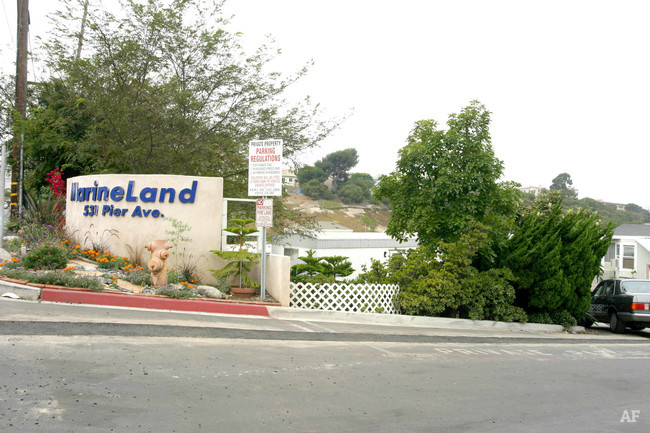
Since the age of 5, Hermosa Beach resident and Mira Costa High School student Isaac Paz has lived in Marineland Mobile Home Park along Pier Avenue.
Marineland is Hermosa Beach’s only low-income housing neighborhood where its residents can live and take advantage of the schools, stores and atmosphere common to an affluent beach town. In recent months, the Hermosa Beach School Board in conjunction with the city of Hermosa Beach explored the idea of a joint purchase of Marineland as a way to provide more space for the School District to build its gym and new classrooms.
The documentary, “A Walk in the Park,” written, directed and produced by Paz, focuses on this issue, and further explores the cultural and social perceptions of those who don’t live in the park on those who do.
Paz, 17, a junior at Mira Costa began his video production career as a freshman and has enrolled in increasingly more difficult video classes since then.
Last year, Paz completed work on an interactive journal project of sorts that centers on his experiences in Long Beach which was where he once spent much of his free time with a friend. In the film, Paz compared the environment of Long Beach to that of Hermosa Beach.
Paz entitled it “A Tale of Dos Cities” and entered it into Mira Costa’s film festival. It won an award for best writing and now “A Walk in the Park” was chosen among hundreds of entries as an official selection of the Los Angeles Film Festival.
Paz is now finishing up a fiction piece based on the somewhat real-life situations of two high school kids who attend the same school and grew up in very different environments. It deals with how they handle certain situations differently and how their choices are partly based on their socioeconomic status and their level of popularity.
The Beach Reporter sat down with Paz and talked about “A Walk in the Park” that will show next month at the Director’s Guild Theater in West Hollywood.
For those who haven’t seen your documentary, what is it about?
The basis of the project we were assigned was to film a documentary about our neighborhood. So, I highlighted the mobile home park situation in Hermosa, the issue of it being up for sale and the School District wanting to buy it. I used that topic as a way to get to know some of the people who live in the mobile home park. Basically the video is about how the city views the park and not just the school but the whole city. It was to show the audience about the people who live in the park and give some information about what’s been going on.
Whom did you interview?
A resident of Hermosa who doesn’t live in the park, a local historian, my brother and a resident who once lived here but recently moved to Oregon.
What was the reaction to the ‘for sale’ issue among the people you interviewed?
Well, one of my interviewees who is a resident but doesn’t live in the park and has kids at Hermosa Valley didn’t really know that there was a mobile home park in Hermosa until a couple of years ago. The park is kind of surrounded by two hills on Pier Avenue and so it’s not all that noticeable, and the only place where you can really see it is on Valley Drive. He told me one day he passed by it and noticed it. The historian I interviewed said it’s a way to offer people with low incomes a place to live and he felt that it should remain there.
What are your thoughts on living in the park?
For me, it was always a lot worse when I was a younger kid because as I was growing up I was hassled about where I lived. But as we all grew older, the kids my age grew out of it and they became a little more mature, and I’m not really hassled about it now. I liked growing up in the park and I felt that because I did people outside the park looked down on my family and me. As a kid I used to worry about that just because as a kid you care what people think of you. As you get older you don’t really care about it and don’t really have the time to worry about it.
Since you’ve lived there almost your whole life, what are some of your fondest memories?
I remember going to the beach every day in the summer and the great thing about living here is that it is right in the middle of Hermosa Beach, so if I wanted to walk to the store it’s right up the street. Clark Field is right down the street and so I remember not having to get into a car to go anywhere.
Would you describe the neighborhood within the park as a close-knit community?
Yes, definitely. Everyone knows everyone around here and no one even thinks to ask to borrow something. People are open with each other.
What was your reaction to the possible sale of the park to the city?
I was very angry. It’s the only place in Hermosa where people with low incomes can live.
Was it hard to be objective in making the documentary?
Yes, kind of but at the same time I didn’t have a problem with finding people to interview who share my opinion. I tried to make it in the style of Michael Moore’s films where he edits his footage to make it look as though there are a lot of people who look secretive about an issue, but it became hard and some people I talked with didn’t want to be interviewed. I did the best I could while sticking to the guidelines of the project.
Is filmmaking something you’d like to do a profession?
Yes, definitely.
Are you planning on going to college for this?
I would like to go maybe to USC, UC Santa Cruz and I’m also looking at some schools in New York City, too.
Who are some of your favorite directors?
Steve Spielberg is cool, but everybody likes him. I like Tony Scott, and Antoine Fuqua who directed “Training Day.” I also like Christopher Nolan who directed “Memento,” and Darren Arnofsky who directed “Pi” and “Requiem for a Dream.”
 The Lazy Sway