As a way to save taxpayer dollars while still retaining the right to legally challenge Redondo Beach if necessary, the Hermosa Beach City Council in a recent closed-session meeting agreed to settle its lawsuit against its neighbor to the south in connection to the Heart of the City project.
Hermosa Beach city officials argued in their suit that the mitigation measures outlined in the plan’s environmental impact report are insufficient in alleviating potential increases in traffic and congestion along the city’s southern border.
“Once it became clear that for a variety of reasons the project had kind of gone back to the drawing board, and there was no longer an actual project on the table, we found ourselves in the unique position of challenging an EIR for a nonexistent project,” said Hermosa Beach City Attorney Mike Jenkins. “That put us in kind of an odd position. How can you ascertain if the EIR was sufficient, was adequate, when you don’t know what the project is? What’s the point of challenging an EIR for a project that may not go forward, that may be very different in the end than the one that was originally approved? So, it became apparent that it was kind of a pointless exercise.”
According to Jenkins, under the law, CEQA allows for a short statute of limitations when challenging an EIR in which a lawsuit must be brought. If a lawsuit is not brought forth within this time, then one is forever precluded from challenging the EIR.
“The problem we faced was that if we just dropped the lawsuit, and Redondo a year from now came up with a substitute project and said, ‘Well, we’re going to rely on the old EIR,’ and we wanted to challenge it because we didn’t like the substitute project any better than we liked the original project, Redondo could argue that we are too late,” said Jenkins “We couldn’t just drop our suit without risking being unable to challenge another project. So, after quite a bit of discussion and negotiation, we arrived at a settlement, a compromise with Redondo.”
Hermosa Beach signed a settlement with Redondo Beach, which was later signed and certified by a judge, that if the city agreed to drop its lawsuit and Redondo Beach approved a new project and relied on the old EIR over the next five years and Hermosa Beach raised a challenge, Redondo Beach is prohibited from arguing that the new suit is barred by the statute of limitations.
“This is what’s called a stipulated settlement,” said Redondo Beach City Attorney Jerry Goddard. “I am always happy to resolve litigation where the parties settle, particularly when it’s without cost to the city. I think what happened is that when Hermosa originally brought the suit they were concerned that Redondo was going to move forward with some type of major development. As things have turned out, that’s not going to happen. Hermosa felt it has achieved what it set out for which was a position where they could argue against development. Things have progressed and gone in a different direction with regards to what’s going to happen on the property and we’re happy to see the lawsuit dismissed because I’d much rather have an empty plate than full plate when it comes to litigation.”
In August 2002, Hermosa Beach asked a Torrance Superior Court judge to grant it a stay on a lawsuit it filed in the spring of 2002 against Redondo Beach, claiming the original Heart of the City plan would create adverse congestion and traffic impacts on Hermosa Beach residents living near its southern border.
In October 2002, Redondo Beach filed a written response with the Torrance Superior Court, urging it to deny Hermosa Beach’s request to retain its right to sue its neighbor to the south if the revision of the Heart of the City plan is as ill-favored as the original.
That same year, thousands of Redondo Beach voters signed a petition to put the controversial plan on a ballot in the form of a referendum to target two zoning ordinances. A grass-roots group called Citizens for a Vote for the Heart of the City, co-headed by now-Redondo Beach City Councilman Chris Cagle, collected 6,000 signatures that basically gave the municipality two options: put the plan before voters or rescind it.
Residents who signed the petition expressed concern about the high density, traffic and noise impacts that the plan would generate in the city. The Redondo Beach City Council rescinded the referendum and was prohibited from proceeding with the plan for one year.
The original Heart of the City plan called for significant changes to Redondo Beach’s waterfront and the AES power plant located along Hermosa Beach’s southern border. The plan would have allowed for up to 675,000 square feet of commercial development and almost 3,000 residential units.
“The allegations in the lawsuit were that the environmental impact report that had been prepared and certified by Redondo Beach did not adequately address the impacts of the project on Hermosa Beach particularly with respect to traffic impacts,” added Jenkins. “So, we preserve our ability to challenge the old EIR for a new project and with that we were satisfied that we would still have that ability to challenge it and on that basis we were agreeable to dismissing our lawsuit. If they come back in a number of years and certify a new EIR, well, then it doesn’t matter, the stipulation is irrelevant, it just starts a new statute of limitations. It gets us everything we basically wanted and it’s good for Redondo as well because it means we eliminate a lawsuit from taking everyone’s time and attention.”
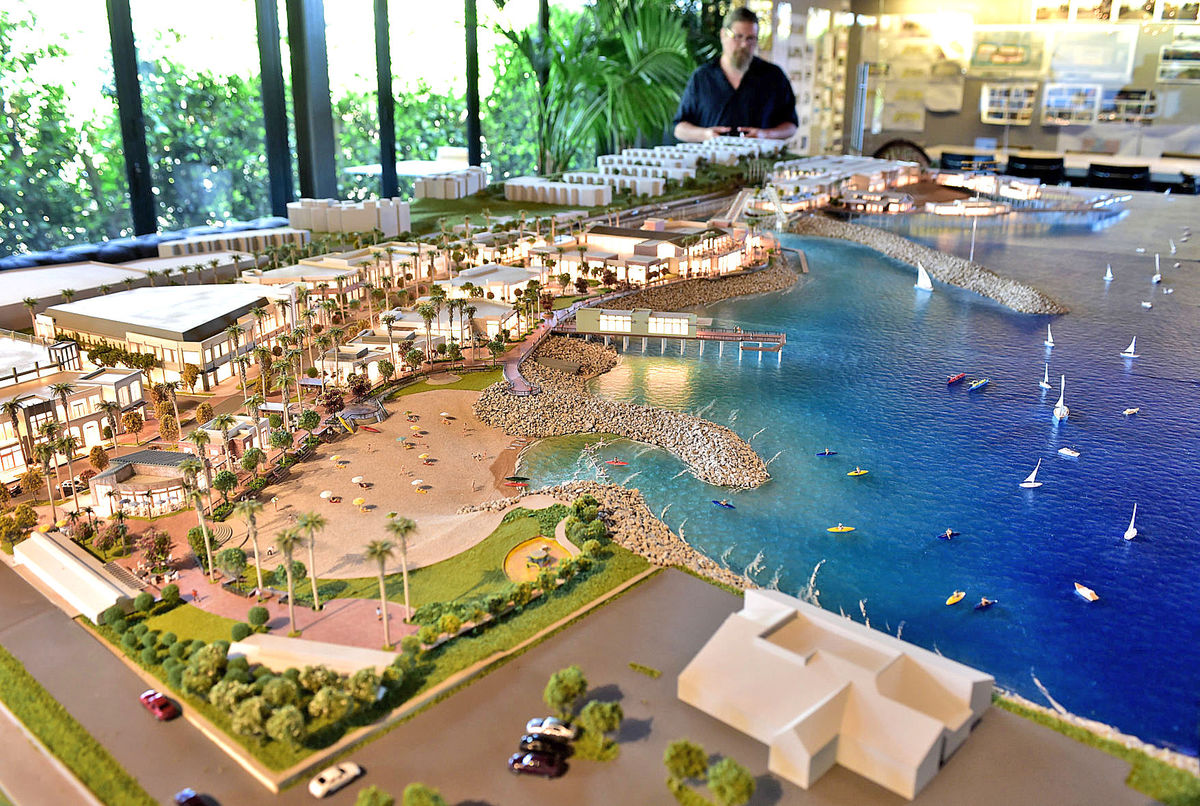
In a public Planning Commission meeting last week, consensus-building groups formed in 2003 with the help of Redondo Beach Mayor Greg Hill and Cagle presented the commission, community members and city officials two different concepts for the area. In July 2003, the Redondo Beach City Council approved what is being called a “community consensus-building” plan. Groups of volunteers devised the plan through a series of public workshops where they developed two unique land use plans for the area dubbed Heart Park and Village People.
The Heart Park plan focuses on open space with playing fields and possibly a few recreational buildings while the Village People plan is an area focused on the combination of commercial, residential and recreational space. The latter calls for a 16-acre park, recreational center and aquatic center; a maximum of 150 single-family homes located on two peninsulas; and 200 townhouses situated along 65-foot-wide canals with public walkways that connect to a five-acre recreation area and a lake the width of a football field.
 The Lazy Sway