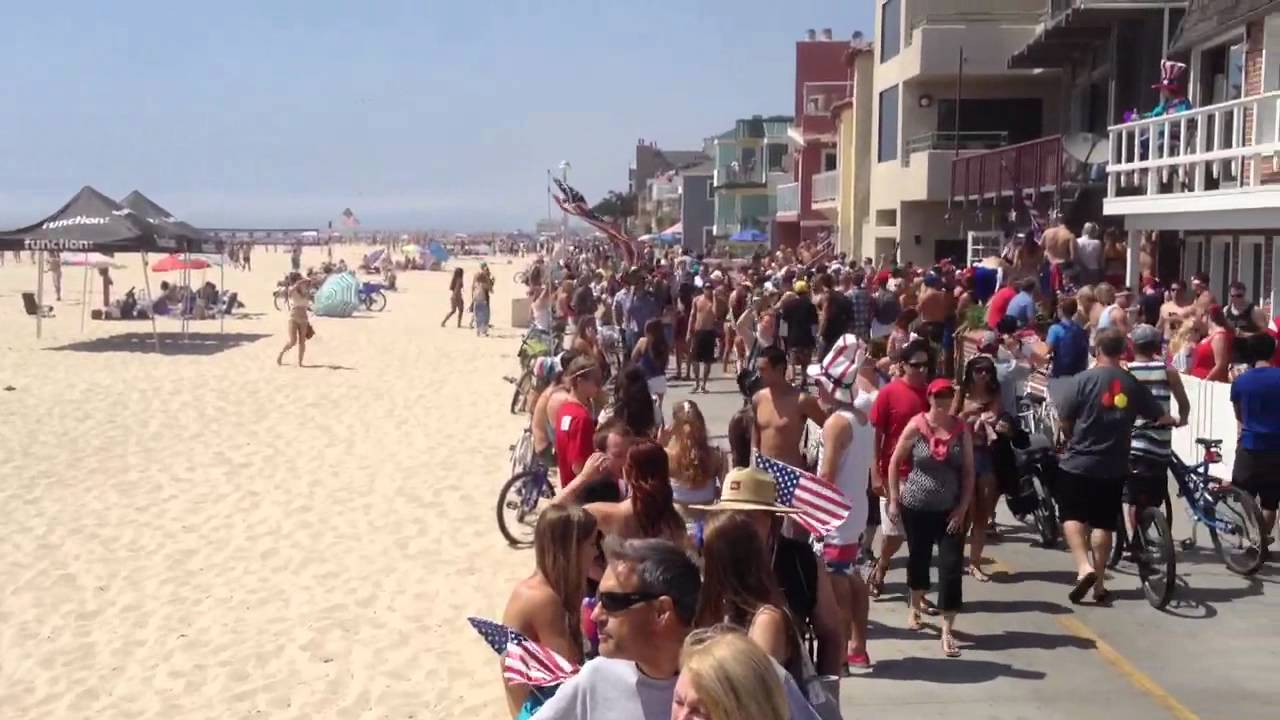
The Strand in Hermosa Beach last week was a subject of debate when the City Council voted to ban Segways from the long stretch of concrete that runs through town along the beach.
The general consensus among the five councilmen – Sam Edgerton, Michael Keegan, J.R. Reviczky, Peter Tucker and Art Yoon – is that adding more traffic to an already congested area is just simply a bad idea.
The issue of congestion and traffic on The Strand is one up for discussion in the near future among the five elected officials as it relates to speeding and accidents. At its next meeting, the council will entertain the idea of changing the city’s municipal code by possibly voting to eliminate the 10-mph speed limit on The Strand and reduce the length of or eliminate altogether the walk zone from 10th to 15th streets.
“I don’t agree with most of the recommendations,” said Yoon. “I don’t support watering down our ordinances because I think it’s equivalent to saying we can’t stop immigration so we might as well open the borders or we can’t stop drug use so we might as well make drugs legal. I think we should enforce the laws we have, although I might consider the reduction of the walk zone. I don’t have a strong opinion on it either way but I’d like to hear the discussion on it before I vote.”
The Strand accommodates all kinds of use from in-line skating, bicycling and skateboarding to walking and jogging. The matter about the speed of those who use manual wheeled modes of transportation, particularly bicycles, has become a growing concern within the community. Many residents feel there are too many people who travel too fast on The Strand and put everyone else at risk. Because of this worry, the Hermosa Beach Police Department, in conjunction with the Hermosa Beach Fire Department, conducted a study of the area in October and December. Both agencies collected current data and compared it to records dating back to 1998 on the speed of people who use The Strand and the number of accidents that have occurred in the area over the past five years. The Police Department is expected to present the findings to the City Council at its next meeting.
“I looked at the report and it’s an obvious expression of frustration on the part of the chief,” added Yoon. “The situation on The Strand is a concern for some residents as evident with the most recent ballot initiative. Enforcement is quite the challenge. I know the police want to clamp down on speeding so that The Strand becomes more pedestrian-friendly and they are doing the best job they can with the resources they have to improve pedestrian safety using the city’s ordinances.”
Police officers collected data thanks in part to a device called the stealth radar machine. They also gathered information based on random observation and enforcement of The Strand.
Officers placed the radar at Eighth Street and The Strand on Oct. 2 through 4. Police then moved it to 18th Street and The Strand from Dec. 5 through 7, and to 19th Street and The Strand from Dec. 12 through 14.
The radar is only able to clock objects including pedestrians, moving at 11 mph or more. In those two days in October, the radar recorded 1,653 objects moving at an average speed of 13.37 mph. The first December study recorded about 731 objects moving at an average speed of 13.36 mph while the second December survey recorded 1,121 objects moving at an average speed of 13.29 mph. Police recorded some objects moving at 15 mph and as fast as 25 mph.
“I’m not in favor of eliminating the speed limit and in fact, I think we should make the speed limit between 5 and 8 mph. I think if you lift a law, people think riding a suitable speed limit doesn’t matter and they take advantage of it,” said Tucker. “I’m not in favor of eliminating the walk zone and as far as reducing it, I think it won’t accomplish anything because it takes a few blocks before people realize they have to walk their bikes. I’m also really concerned with the motorized scooters and skateboards that people are illegally riding down there.”
The Hermosa Beach Fire Department recently compiled statistics related to accidents on The Strand spanning a five-year period (1998-2002). According to its findings, a total of 128 accidents occurred on The Strand over this duration. Of those accidents, about 20 (15.6 percent) of them involved a bicyclist or a skateboarder with another skateboarder, pedestrian or bicyclist. About 84 percent of the 128 accidents were ones involving just one person. Over the past five years, the Fire Department cited a steady decrease in accidents from 33 in 1998 to 21 in 2002.
Accidents involving bicyclists and skateboarders declined from four cases in 1998 to one in 1999 to zero in 2000 and 2001 to one in 2002. Falls from skateboards also decreased from 13 cases in 1998 and 1999 to four in 2000. It rose slightly to five in 2001 and then declined to four in 2002. The only accident involving a skateboard and a pedestrian occurred in 1998. Cases involving a bicyclist and a pedestrian reached two in 1998, went down to one in 1999 and back to two in 2000 and 2001, and back down to one in 2002. The Fire Department recorded three accidents involving two bicyclists in 1998, one in 1999, zero in 2000, one in 2001 and zero in 2002. The only category in which the cases rose was in falls from a skateboard that increased from one in 1998 to two in 1999 to one in 2000 to three in 2001 to five in 2002.
In reviewing such data, the Police Department concluded that speeding on The Strand is not a major problem.
“While it certainly does occur, it does not occur to the extent that has resulted in numerous accidents and injuries,” stated Lavin in his report.
The City Council will look into the idea of altering the city’s municipal codes based on three recommendations provided by Lavin and City Manager Steve Burrell. The first recommendation is the elimination of The Strand’s 10-mph speed limit.
“This speed limit is very arbitrary. Based on experience and observations, there are times when 15 mph would be safe and there are times when 8 mph is too fast. There is very adequate language in (the municipal code) to allow officers to cite violators who are traveling at unsafe speeds based upon existing conditions or for reckless and careless operation of any wheeled vehicle,” stated Lavin. “Additionally, most officers are not equipped with radar. Radar is assigned to traffic officers who operate these units on public streets. Without a radar gun, an officer is left to his own observations and opinion as to what is more or less than 10 mph.”
Both the second and third recommendations relate to the city’s current walk zone from 10th to 15th streets. Lavin and Burrell suggested reducing the area to include 11th Street to 14th Street or to eliminate the walk zone all together.
“Staff feels that this walk zone is too large and unreasonable,” states Lavin. “The walk zone also creates some confusion for bicyclists and skateboarders who can ride legally on pier plaza yet illegally as they cross onto The Strand into the walk zone area. The walk zone is too difficult to enforce on a consistent basis. The Police Department does not have the resources to assign officers to this area on a regular basis for enforcement purposes. There are other high-priority activities for officers to be involved in.
“Fortunately, most people slow down and/or walk their bikes through this area when it is crowded. Thus, The Strand is self-regulating. Finally, there exists sufficient language in the municipal code to deal with speed issues on The Strand. (The municipal code) allows the police to cite violators observed anywhere on The Strand who are traveling either too fast for conditions or in a reckless and careless manner.”
 The Lazy Sway