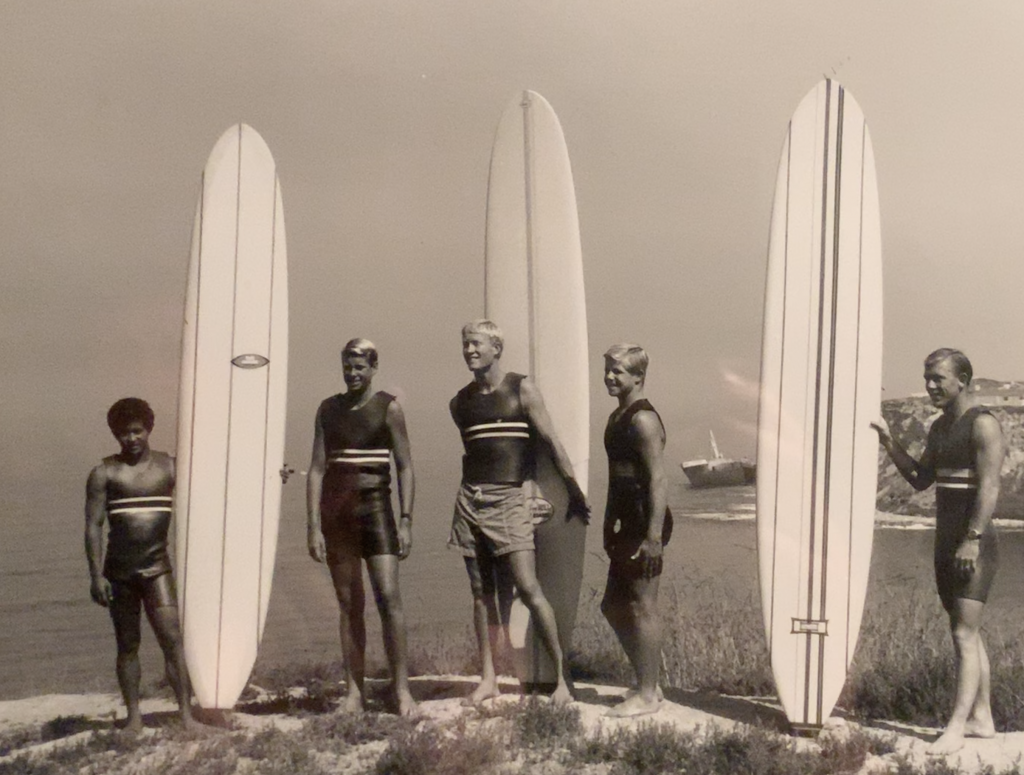
Considered by many as the birthplace of Southern California surfing, Hermosa Beach is known all over the world as a beach town made famous by legends like Dale Velzy, Greg Noll, Hap Jacobs and Mike Purpus.
During the 1950s and 1960s, Hermosa Beach became a Mecca for the longboard surf culture, and a hot spot for up-and-coming and established surfboard-shaping companies.
One surfer in particular not only embodied the early beginnings of a now-popular and growing surfing community as a talented surfer and surfboard shaper, but he also looked the part with his platinum blonde hair and tan, muscular figure.
Born in 1938, Dewey Weber grew up in Hermosa Beach and attended Mira Costa High School. By the age of 14, Weber was already a three-time Duncan Yo-Yo champion. In high school, Weber became a three-time CIF wrestling winner and an All-State competitor at El Camino College. He continued to compete as an amateur until a dislocated elbow cut his wrestling career short – an injury that resulted in Weber losing a spot on the 1960 American Olympic team which traveled to Rome that year for the Games.
Upon graduation from high school in 1956, Weber visited the big island of Hawaii for a surfing trip with 13 other friends.
Weber was a small man standing only 5-foot-3. He earned the nickname “Little Man On Wheels” for not only his height, but for his outlandish, aggressive and unique surfing style. Hermosa Beach native and well-known photographer Leroy Grannis captured Weber’s intriguing technique in a picture where he performed his trademark “wheelhouse cutback” in the water at Hermosa Beach’s 22nd Street in 1966.
“It is the most famous surfing photo in the world and Laguna Beach even recreated it for a 25-foot art mural advertising its art festival. The name Dewey Weber is the most recognizable name among surfers,” said surfing enthusiast John Joseph.
The photograph recently received attention at the Hermosa Beach City Council level as the model of a life-size replica statue a group of private citizens will fund and place at the southwest corner of Pier Avenue and Pacific Coast Highway.
In recent weeks, the municipality approved a project that will recognize Hermosa Beach’s surfing past, honor one of its most famous personalities and credit one of its greatest photographers. The city approved the installation of the statue that will work in conjunction with its gateway sign that will welcome visitors into the small beach town.
“We believe this sign and statue define the surfing culture of Hermosa Beach,” said Public Works Commissioner Jean Lombardo.
The idea for the project came from the city’s Public Works Commission and the group of appointed commissioners further developed the proposal with a subcommittee of Commissioners Lombardo and Victor Winnek.
“Dewey Weber stands out as a clear choice for this statue because he was one of the first media surf stars who sadly passed away 10 years ago at the age of 53,” said Public Works Director Richard Morgan. “Surf photographer Leroy Grannis, also born and raised in Hermosa Beach and a legend in his own right, captured the timeless photo of Dewey surfing at 22nd Street in 1966, which was featured in Surfer magazine.”
It was proposed that private donations would subsidize the project, and Morgan suggested a fund-raising effort would be easier if the gateway statue were of a famous surfer who represents the surfing period of the 1960s. Morgan estimated the cost of the statue to be between $150,000 to $200,000. The statue will sit on the southwest corner and a gateway sign will sit on the northwest corner of PCH and Pier Avenue.
“The city wishes to give permanent recognition to the donors making this exciting project possible,” said Hermosa Beach Mayor Michael Keegan. “The perimeter wall and walkway around the statue will incorporate bricks with the engraved names of the ‘Friends of Dewey.’ For a donation of $200, you can have a personalized brick that will be a permanent part of this beautiful tribute. A bronze plaque will also be included to recognize donors of $5,000 or more. We recommend the special ‘Dewey Deal,’ five bricks for only $1,000 and a free T-shirt.”
Donors will also receive an 8-by-10-inch glossy copy of the famed photo signed by Leroy Grannis, along with a “Friends of Dewey” T-shirt. Those who are only able to donate a small amount may purchase a T-shirt for $25.
“Dewey was one of the most prominent Hermosa Beach athletes and the photo on which this statue will be based is one of the most famous surfing photos in the world,” said lifetime resident Rick Koenig.
In the summer of 1960, after forgoing an athletic college scholarship, Weber, then 22, borrowed $1,500 and established a small surf shop in Venice. He began making and selling surfboards out of the shop and would surf every day. Within five years, Weber had expanded his business to include 50 employees, along with operating four retail stores located in both California and Hawaii. Weber’s company began to produce 100 surfboards a day. He was said to have reformed surfing with the first cut-away fin.
Weber was one of the first inductees of the International Surfer’s Hall of Fame in 1966 at the age of 27. He died in January of 1993, and his life’s work was featured on various television stations and in major publications. Weber’s family – wife, Caroline, and children Stacy, Shea and Corey – continue to operate Weber’s ever-growing business in the wake of a rebirth of longboard surfing.
Those interested in making a donation may send donations to the city of Hermosa Beach, attention Rick Morgan, 1315 Valley Drive, or may call Morgan for more information at 318-0211.
 The Lazy Sway