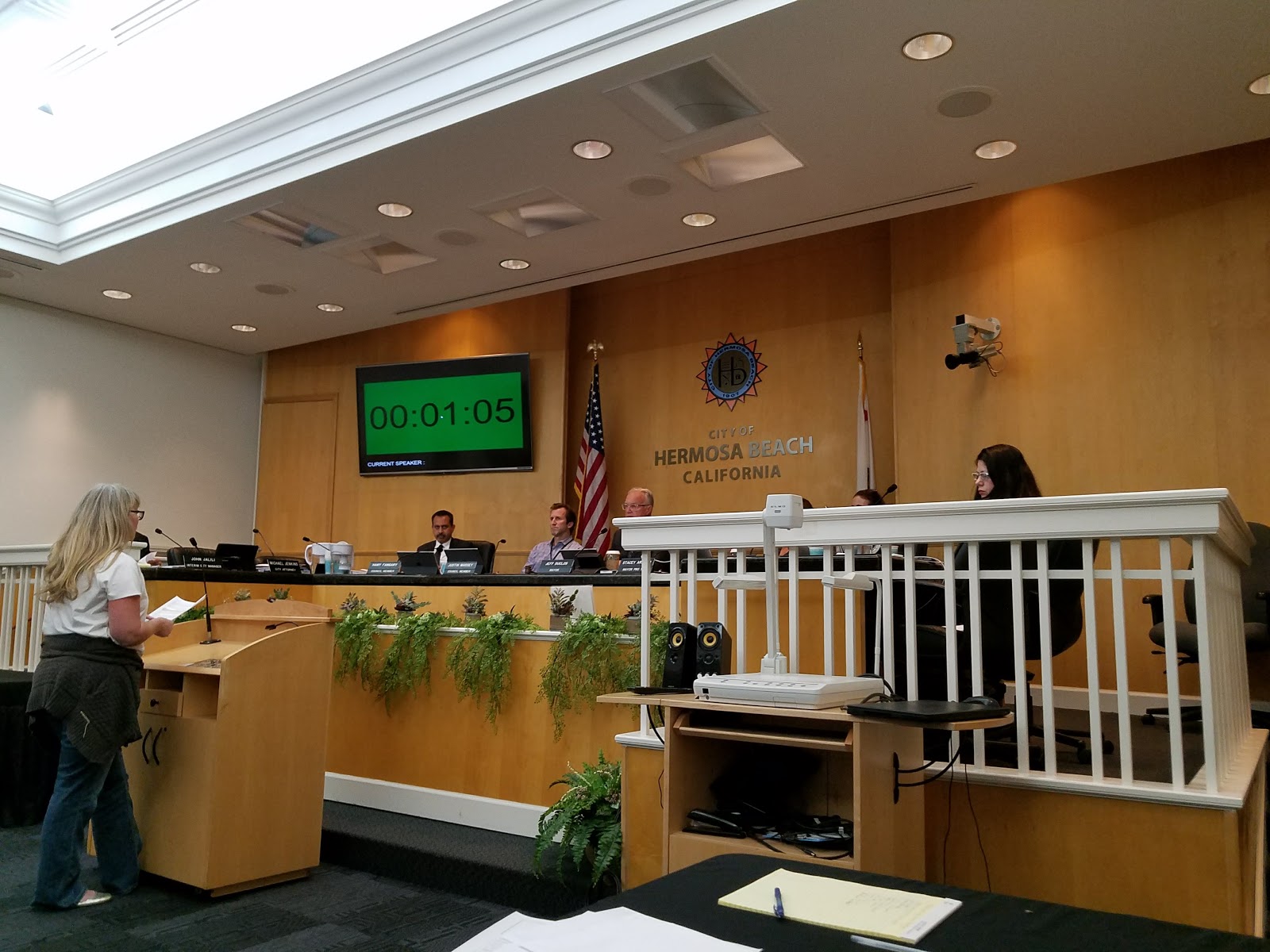
Candidates competing for two open seats on the Hermosa Beach City Council last Wednesday participated in an open public forum hosted by the Women’s Club of Hermosa Beach in conjunction with the League of Women Voters at the Clark Building. Following the debate, proponents and opponents of two ballot measures presented their contrasting arguments to the large group in attendance.
The candidates – comprising Alan Benson, David Cohn, Charlie Cheatham, Sam Edgerton, Richard Gebele, Howard Fishman and Pete Tucker – discussed everything from balancing the budget to city and school relations to the proposed separate bike path.
Candidate David Cohn was not present at the forum.
The question of how to enforce occupancy limits in restaurants and bars was one of the first questions posed to candidates. Benson, who works as post-production supervisor, believes the Fire Department should take a more active role in shutting down businesses that violate their occupancy limits.
“As far as enforcement, this is one area restaurants must follow since they are based on the regulations set out by the Fire Department,” he said. “I would advise the Fire Department if it sees an overcrowded establishment to go down there and clear it out, but that’s obviously a huge danger and overcrowding in bars is a big problem.”
Fishman, a Hermosa Beach Parks and Recreation Commissioner and Manhattan Beach’s risk manager, said the occupancy should be enforced and the city should make an effort to meet with individual business owners to discuss such laws and what is expected of them.
“As you know, we do have occupancy laws that are there really to protect the people who frequent the bars and the restaurants,” he said. “I feel it’s important that we enforce the regulations and the same time, if there is some leeway in any of these regulations. For example, the Comedy and Magic Club, there seems to be some dispute on how to define the usage in the restaurant. So I think it’s important that the city get together with the merchants and come up with some determination as to what’s appropriate for a particular restaurant, though if we have these laws on the books, they should be enforced.”
Cheatham, who is a Public Works Commissioner and a manager in the aerospace industry, agreed with Fishman by saying the city should meet with merchants to make sure they know the laws and said the city should implement a review process for business CUPs.
“Well, we have these codes and they do need to be enforced by the police and our code enforcement officer,” said Cheatham. “We do need to work with our local businesses to make sure that they understand the codes and that they are willing to take the measures necessary to correct any problems.”
Peter Tucker, a Redondo Beach building inspector and Hermosa Beach Planning Commissioner, talked about his involvement with the Comedy and Magic Club and its owner, Mike Lacey, who disputed the establishment’s occupancy for more than two years.
“I’m currently employed as a building official for another municipality, and I want to point out with great pride that I worked with the Comedy and Magic Club and its architect so it could increase its occupancy load,” said Tucker. “This was accomplished by the building codes that we already have in place. I feel as a building official, and if I do take the office of City Council, I take an oath of office to uphold the laws of the state and our municipal codes. There’s no one answer for occupancy loads, so I feel we do need to enforce them but also we do have mechanisms that can increase an occupancy load.”
Incumbent Sam Edgerton, who is the owner of his law firm, also noted his involvement with the Comedy and Magic Club issue and the city’s responsibility to uphold the Uniform Building Code in a fair manner.
“First of all, occupancy is governed by the Uniform Building Code. It’s there in black and white, and it’s there for the benefit of the city and also for the person who has the business,” he said. “It’s there to maintain safety, so you don’t have too many people inside an establishment where it might be a fire hazard or something else. It’s a two-way street in that I definitely believe in strict enforcement of the code as to the number posted which should not be exceed.
“But we have found in the city, like with the case of the Comedy and Magic Club, Mike was being told two things. What I found out, and I will admit when the city’s wrong since I’m not going to stick up for the status quo because it might be politically correct, is Mike was getting a bad deal. We were applying the wrong math to this equation and took someone to read the code like myself to understand it, explain it to the city and that’s why he’s still in Hermosa Beach today.”
Richard Gebele, a real estate developer and owner of his own firm, talked about his own personal experience when he built his own house and feels the city’s Building Department needs to be more consistent in its rulings.
“I think that the occupancy codes should be enforced and I think that the Comedy and Magic Club issue wasn’t an issue of occupancy, but more of the inconsistency of our city government,” he said. “He was given misinformation when he went through planning to building to operating. Similar things happened to me when I built my home and I’ve been contacted by other people who have similar experiences. The city needs to be concise, accurate and respond to the citizens.”
Another question posed to each candidate was how to balance the city’s budget without raising taxes and would they consider outsourcing some of its services.
Fishman believes the city should keep some of the open positions a part of the nonessential category in a frozen state to save money.
“I think it’s extremely important that we do balance our budget and actually according to state law, you’re required to have a balanced budget,” he said. “Some of the things I would look at as your City Councilman would be to look at the vacancies right now that exist and determine whether or not we should keep those vacancies in a frozen state. I would not, however, support freezing positions that involve public safety or any of those positions that could potentially generate revenue such as a parking enforcement officer or a code enforcement officer. I would also look at nonessentials in the budget that would include things like memberships, subscriptions, and conferences. I would also look at delaying vehicle replacement schedules where needed, but again for safety, I would not do that. I would look at reducing the city’s liability premium; I know we could save at least $50,000 by doing that.”
Charlie Cheatham suggested forming budget task forces.
“In my federal government job, we’ve faced many tough times with budgets. My agency has downsized from 29,000 to 11,000 people and I was one of the key managers who helped evaluate that,” he said. “One of the ways we did that was to form budget task forces. We put together these forces, went into offices and evaluated their priorities and how they are spending their budgets. Then we looked at alternatives we could implement that would continue to maintain a high level of services we had but also meet our current budget climate. I would like to propose forming task forces with the community, commissioners and City Council members to look at department budgets.”
Tucker thought the city should maintain its fire and police services and exhibit more shrewdness when spending.
“I don’t feel we should increase taxes, it just gives our government more to spend. We need to run our city like a business. I come from the private sector and now I’m a civil service employee, and I can see why sometimes cities are in the problems they are,” he said. “As far as outsourcing goes, I think everyone wants to maintain our police and fire, and I think it’s essential that we do that. We have a very good response time and I think it’s key that we keep them in place. We need to buy smarter and really look at our budget when we purchase things and get more bang for our buck. I’m one who really doesn’t like the word ‘consultant.’ I think we have enough people in our city to help us in the consulting end to help us save money in that aspect.”
Edgerton, who has sat on the City Council for the last 12 years, talked about keeping events that make Hermosa Beach unique.
“I had the dubious distinction of being the person here who had to participate in budget cuts on the City Council in 1992 and 1993,” he said. “It’s never fun, those are hard choices, but like any business that’s in a down market, you have to do something to keep your business solvent and healthy, and look toward the future. The first thing you do is with those people who are leaving their jobs of nonessential positions, you just don’t fill those positions. You save a lot of money that way. Our budget is basically about $16 million for the General Fund from appropriations, our property taxes are $5 million, and the state will come in and it will probably cut the car taxes or in other areas, and we are expected to lose about $1 million. We get very aggressive across the board on nonessential positions and we don’t take on any new functions. Having said that, I very much want to keep things for the community that are cheap, inexpensive and fun. When New York City was going through all of its troubles, it never cut the St. Patrick’s Day Parade and I don’t intend to do that here. So I want to keep the Sunset Concerts, Aloha Days and all those fun things for the city while we go through these tough times.”
Gebele believes the city could participate in more outsourcing and should take care of minor projects that maintain the city’s character.
“I would look at all options for the budget,” he said. “I would look at outsourcing all of the departments. I know the Fire Department is understaffed and by its own studies it would like to double. If we can provide that by outsourcing, provide twice as many firefighters and cut the response time, why wouldn’t you look at that? The Planning and Public Works departments and other areas within the city can all be outsourced. It provides more accountability and it cuts costs. For example, if you want the center of Clark Field, it’s a swamp. We pay top dollar for landscaping people and things don’t get done.”
Benson agreed with Cheatham in creating some kind of task force and believes the city needs to study the problem further.
“I agree with some type of budget task force,” said Benson. “In this type of situation it’s important to know how bad the problem is. It sounds likes it’s more than a million dollars and that’s a pretty big chunk of money. I would agree with outsourcing except where the area of safety is involved. It’s a complex topic and it’s going to take a lot of study to find out what the problem is. One thing I would like to know is how far in advance did we know about this problem? As I understand one of the problems is a drop in the retirement fund and the city is going have to make that money although the stock market has been down for a couple of years so the drop in the retirement fund should have been well-known in advance.”
Measures
Following the candidate forum, a local activist spoke on the issue of a veteran’s preference program since no official opposition has surfaced against the measure. A former City Councilman in favor of a separate bike path squared off against a local resident opposed to the idea.
Steve Crecy of the Hermosa Beach Veteran’s Memorial and member of the South Bay Chapter of the Vietnam Veterans of America, spoke on behalf of Measure “V,” a ballot initiative that will determine whether military veterans will receive special scoring preference on their competitive employment exams. Measure “V” proposes the adoption of an ordinance that would give veterans a 3-percentage-point credit on civil service examinations.
According to an impartial analysis of the measure, the City Council adopted the ordinance that governs city employment as a ballot measure so that voters will maintain final judgment on whether they would wish to provide veterans with special preference.
“This ordinance would amend the civil service ordinance to extend a credit to the examination score of applicants who are military veterans,” states Hermosa Beach attorney Michael Jenkins. “A veteran means any person who has been discharged or released from military service under conditions other than dishonorable and has served full time for 30 days or more in the armed forces in time of war; or for 30 days or more or in time of peace in a campaign or expedition for service in which a medal has been authorized by the government of the United States; or during the period Sept. 16, 1940, to Jan. 31, 1955; or for at least 181 consecutive days since Jan. 31, 1955.
“A veteran does not include any person who served only in auxiliary or reserve components of the armed forces whose service therein did not exempt him or her from the operation of the Selective Training and Service Act of 1940.”
A “yes” vote would mean someone is in favor of establishing credit for veterans who compete for city positions while a “no” vote would be opposing such a credit.
Those in favor of the measure include City Council members J.R. Reviczky, Kathy Dunbabin and Sam Edgerton; Mayor Michael Keegan; and Crecy.
“Our freedom is being protected today as we speak by military personnel, many of whom will become veterans,” said Crecy. “Back in 1999, the state passed a piece of legislature requiring cities to address veteran’s credit. Our state constitution endorses and encourages veteran’s credit. The reason we like to call it veteran’s credit is because we feel this is recognizing service that has been provided and given by the veteran. We also feel this a way for our citizens as a whole, to say thank you.”
Compelled by numerous requests from dozens of members of the South Bay chapter of the Vietnam Veterans of America, the Hermosa Beach City Council agreed to reconsider the proposed program after its Dec. 11 meeting where it voted to reject the plan. Reviczky was the only one who voted in favor of it.
According to civil service rules, veterans, like anyone else applying for a city job, must possess the appropriate skills specific to a position through competency testing before they are awarded any points.
Cities that have already adopted special preference for veterans include El Segundo, Gardena, Inglewood, Manhattan Beach, Redondo Beach and Torrance.
The veterans preference program was sponsored by the state of California. Part of the legislation required all city agencies to either adopt the program or adopt a resolution explaining the reasons as to why it won’t implement such a policy by January 2002.
The program is based on civil service employment exams, which are administered to virtually every entry-level city employee, firefighter and police officer.
Former Councilman John Bowler faced off against Robert Aronoff, a local resident and founder of Keep the Beach in Reach, a grass-roots organization aimed at fighting Measure “W.”
Measure “W” is an advisory ballot measure, so its function is to ask voter opinion on whether the City Council should consider building a separate bike path on the beach.
“If further consideration were given to such a project, the city would have to prepare plans and cost estimates, conduct environmental review, determine financing and obtain approval from the California Coastal Commission,” stated City Attorney Mike Jenkins in his impartial analysis. “The process would involve public hearings at which all interested persons could express their views. A ‘yes’ vote means that you favor further consideration of a separate bike path. A ‘no’ vote means that you do not feel that the council should consider the matter further.”
In recent months, Bowler backed the idea of placing the issue in the hands of Hermosa Beach voters by way of an advisory measure, which will gauge resident approval or disapproval of such a project. If 51 percent of voters say they would support the idea, the City Council will then initiate an analysis on the feasibility of constructing one long stretch of concrete on the beach.
“The primary part of this issue that you have to understand as it’s been noted is it is an advisory vote to ask the City Council to consider building a bike path,” said Bowler. “I think for me it is simply an issue of common sense. It does not make sense to mix pedestrians, small children and animals on leashes with faster moving skateboarders, in-line skaters and bicyclists. It doesn’t make sense and that’s why we build sidewalks in communities because it doesn’t make sense for people to be walking among high-speed vehicles. Should we come with all of the details before studying it? I say no. My experience on the City Council is this. It takes enormous amounts of manpower and time expended to study an issue. Why should we go through all of that if no one’s interested in doing it? I say ask the question first. Is this something you think the city should look at? If the majority of the citizens agree, then you send out for engineering studies and drawings and budgets to be made up. Those are things that can be worked out in public sessions where you all have a chance to give input and find the best solution to doing it. I will tell you one thing in terms of details. I would not be in favor of this if I believed the city was going to have to spend money out of its own pocket to do this. This is paid for by your transportation dollars, your gas tax dollars, federal, state and county taxes. When we remodeled the north end of The Strand, the first thing we did was rename that area a bike path because by doing that it qualified for all sorts of alternative funding.”
Proponents claim a separate bike path would reduce safety concerns related to Hermosa’s current path where bicyclists and skateboarders share the same long stretch of concrete with pedestrians and baby carriages.
“It’s nice to say this is just advisory, but you heard the candidates that if the vote goes in favor they will follow the will of the people. So if you vote ‘yes’ on this, you are giving the City Council a mandate to pour millions of dollars of concrete on our beautiful beach so there is nothing advisory about this,” said Aronoff. “This is the only chance you will have to vote on this. How many hearings in your lifetime, and many of you have lived here for years, are you going to go to protest this? Do you see yourself going to hearing after hearing and putting your say into this bike path? This is your chance to vote ‘no’ and keep the concrete off our beach. The City Council can study this. This is what we elect these people to do. Let them give the facts to us. Everyone assumes that it must be safer, but the statistics don’t add up. The statistics show that bike path accidents are mostly caused by speed, second by surface conditions and after that is collision. The arguments against the bike path fall into four categories. The first one is environmental, people don’t want concrete on the beach; the second is safety, the bike path is going to be unsafe to cross; third is cost, it’s going to cost millions of dollars based on the remodel; and finally, it’s just bad government. No other alternatives have been explored by the City Council.”
The City Council waited to address the matter until the California Appellate Court had an opportunity to interpret Hermosa Beach’s 96-year-old deed as to whether bikes were considered “wheeled conveyances” which are prohibited on the beach. Since the city owns its own beach – unlike other neighboring cities where the county owns the beach — it must abide by its deed.
In April of 2002, the California Appellate Court agreed with Hermosa Beach officials by ruling that the deed to the beach gives it permission to build a separate bike path on the sand. The issue first became a topic of debate in 1995 when Hermosa Beach officials sought court judgment on the beach’s deed drafted in 1907. The deed includes a clause that sought to prevent cars from driving on The Strand. The decision relieved the city of any restrictions in building a bike path on the beach.
Several City Council members have always believed the construction of a separate path is somewhat controversial among residents and thought if it ever did come to the forefront again, it should go before the voters by way of a ballot initiative.
In 1995, the Hermosa Beach City Council agreed to seek a ruling on the beach’s deed prior to any discussion on earmarking public funds for a proposed project.
In 2000, the city filed a motion with the courts seeking declaration that it could build a bike path if it chose to do so. In 2001, the matter came before a trial hearing and the court ruled in favor of the city. The court reviewed the deed’s ambiguous language which cites a ban on what it terms “wheeled conveyance” on The Strand.
The city asserts the deed was written to keep cars and horse carriages off the beach and The Strand. The court agreed with the city, and ultimately granted victory to it, after translating the deed’s wording and concluding that bikes are excluded from such a prohibited use.
 The Lazy Sway