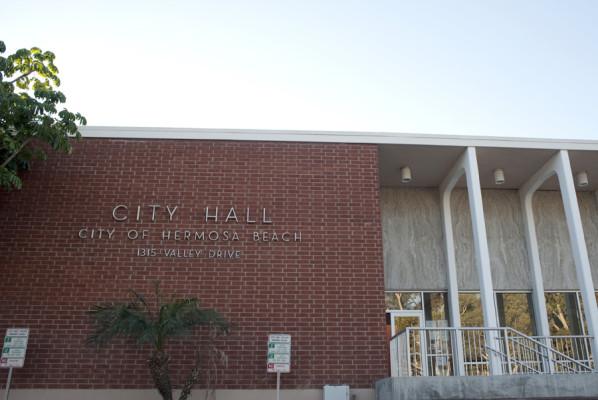
Six candidates vying for two open Hermosa Beach City Council seats Monday participated in an open forum where they addressed a bill of rights supported by local resident Kathy Bergstrom. Bergstrom hosted the public debate inside the City Council chambers.
The candidates – Alan Benson, David Cohn, Charlie Cheatham, Richard Gebele, Howard Fishman and Pete Tucker – debated on issues related to the bill of rights which included everything from the enforcement of conditional use permits to economic development to balancing the budget. Incumbent Sam Edgerton did not attend Monday’s debate.
“There are four other forums and I’ll be more than happy to debate any of the candidates,” said Edgerton. “I’ll be attending all of the other debates where we will all be able to express our views in a fair forum with a neutral moderator.”
Each candidate began the forum by stating their response to the bill of rights and Cohn felt Hermosa Beach is a unique city that he hopes to maintain if elected.
“I’ve lived in Hermosa Beach six years this coming February,” said Cohn. “It’s like one of my fellow residents said, ‘Living here is like having one foot in 1950 and one in 2003.’ Frankly, I think it’s important to try and keep that balance. Part of that process is endorsing the bill of rights. These rights are about improvement, not change, and these rights, in my opinion, force the city government to be more visionary.”
Fishman’s overall view of the bill of rights is what he said to be a process that encompasses all aspects of town.
“We must create a vision for Hermosa Beach and we must define whom we want to be and how to get there,” said Fishman. “To do this, we must develop a process that includes residents and other segments of our community.”
The first question posed to candidates was what they thought to be the most important right. Benson felt the most important was first consideration in all plans and decisions affecting the quality of life in town.
“The majority of people here are residents and not businesses, and it doesn’t mean we have to be anti-business, but I think it does mean we need better representation for the residents on the City Council and city management,” said Benson. “I would like to see a moratorium on the expansion of liquor licenses. I don’t have a problem with small restaurant needs such as beer and wine licenses, and I’m not against bars and nightclubs, but I’m against the expansion of nightclubs and bars.”
Gebele considered the most important right is the right to a balanced city budget.
“I can appreciate the frustration that must have occurred for the people who created the bill of rights,” said Gebele. “I think the most important right is a balanced city budget and I think it starts with an efficient city management. The most important thing in my mind is to control the things we can such as maintaining the parks. I think we also need to show investors that we have a consistent building department so that they will want to create new business. As far as the budget, I think it needs to be analyzed in terms of costs since it has continued to increase over the years.”
Another question posed to candidates was how the Chamber of Commerce could mitigate traffic and parking in relation to special events. Cheatham felt the chamber should take more of a proactive response to generate revenues by way of the local economy, comprising 9,000 households with an average income of $100,000.
“I would like the Chamber of Commerce to help the city drive a new economic model that best serves the needs of the residents rather than staying focused on the tourists,” said Cheatham. “Granted, we will always be a tourist destination, but I would like to see the business community better sustained by the economic engine we have here.”
Another question posed to candidates was how they would improve the enforcement of conditional use permits in town and Tucker, who’s a planning commissioner, explained the role of public entity in the matter.
“We have a new mechanism in place to monitor CUPs,” said Tucker. “When any business changes ownership, the owner comes before the Planning Commission and we remind them of the conditions of their permit with the notification of a six-month review and a yearly review after that for as long as they are in business. So if any business owner gets too many strikes, they will then go to a hearing.”
 The Lazy Sway