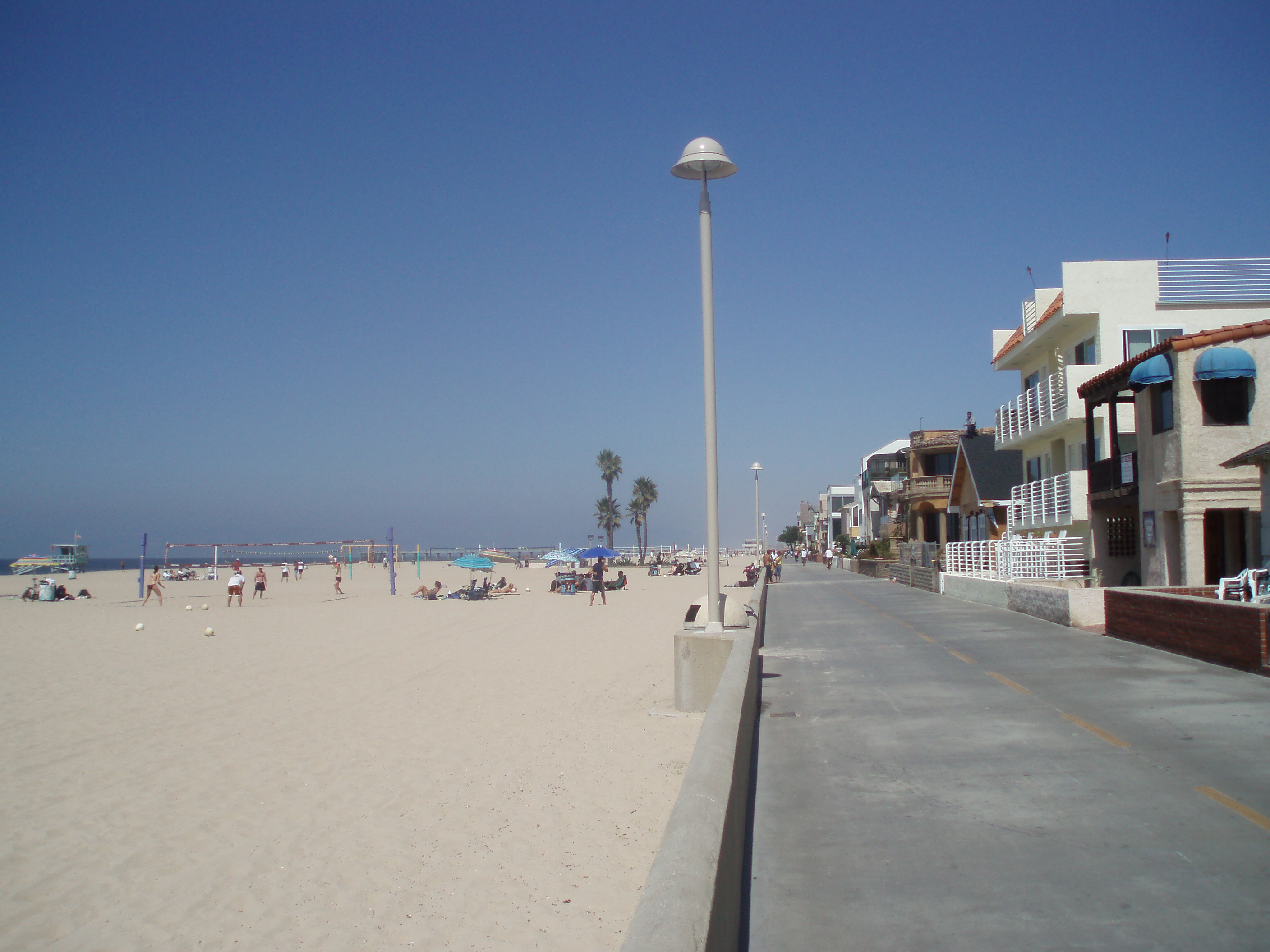
To build or not to build, that is the question. It’s a question Hermosa Beach voters will get to answer this November when they decide whether the City Council should examine the notion of building a bike path west of the city’s strand.
Those in support of and opposed to Measure “W” are now taking sides on the advisory initiative, and comprise elected officials, local athletes and active residents. Resident Robert Aronoff recently formed the committee “Keep the Beach in Reach,” taking a stance against the measure. His fellow supporters include a former mayor, Gary Brutsch; “Stop Oil” activist Rosamond Fogg; professional volleyball player Eric Fonoimoana; resident Katharine Bergstrom; and the president of Friends of the South Bay Bike Path, Dean Francois.
Those in favor of a separate bike path include City Council members J. R. Reviczky and Kathy Dunbabin, former Councilman John Bowler, Parks and Recreation Commissioner Stephen Francis, City Treasurer John Workman and former Councilwoman Julie Oakes.
Measure “W” is an advisory ballot measure, so its function is to ask voter opinion on whether the City Council should consider building a separate bike path on the beach.
“If further consideration were given to such a project, the city would have to prepare plans and cost estimates, conduct environmental review, determine financing and obtain approval from the California Coastal Commission,” stated City Attorney Mike Jenkins. “The process would involve public hearings at which all interested persons could express their views. A ‘yes’ vote means that you favor further consideration of a separate bike path. A ‘no’ vote means that you do not feel that the council should consider the matter further.”
In recent months, Bowler backed the idea of placing the issue in the hands of Hermosa Beach voters by way of an advisory measure, which will gauge resident approval or disapproval of such a project. If 51 percent of voters say they would support the idea, the City Council will then initiate an analysis on the feasibility of constructing one long stretch of concrete on the beach. The path would most likely connect to Manhattan Beach’s bike path at the north end of town and lead into Redondo Beach’s at the south end.
Proponents claim a separate bike path would reduce safety concerns related to Hermosa’s current path where bicyclist and skateboarders share the same long stretch of concrete with pedestrians and baby carriages.
“Hermosa Beach is the only city in the South Bay without a separate bike path parallel to its strand walkway,” said Reviczky, author of the ballot argument supporting the measure. “This has caused innumerable safety issues. Pedestrians, including the elderly, parents with small children, mothers pushing infants in strollers and people walking their pets are forced to dodge speeding cyclists, skateboarders, and in-line skaters.
“Likewise, people looking to enjoy their exercise on these devices are forced to weave a path through pedestrians often oblivious to their presence. It only makes common sense to separate these activities so that each group can enjoy themselves in relative safety.”
Measure opponents assert building a separate bike path doesn’t necessarily mean a reduction in accidents on The Strand, and further contend the answer to improving safety is through education and enforcement.
“The proponents fail to show how building a mini-freeway (that must be crossed to get to the beach) will improve safety,” stated Brutsch, author of the ballot argument against the measure. “It has not been shown that any city in the South Bay incurs fewer injuries on its bike path than Hermosa Beach. The facts are: without building a second unsightly sea wall a new bike path will create sand hazards to cyclists, skateboard riders and in-line skaters; higher speeds on a dedicated bike path will be a serious hazard particularly next to volleyball courts and beach goers enjoying other pastimes; injuries may actually increase; a separate bike path will not eliminate mixed use. In-line skates, skateboards, etc. will be found on both paths; and enforcement and maintenance costs will increase. Adding another strand adds another set of problems and costs.”
The City Council waited to address the matter until the California Appellate Court had an opportunity to interpret Hermosa Beach’s 96-year-old deed as to whether bikes were considered “wheeled conveyances” which are prohibited on the beach. Since the city owns its own beach – unlike other neighboring cities where the county owns the beach — it must abide by its deed.
“Unlike Manhattan Beach, our beach is narrower and we have no elevated berm separating the proposed bikeway from the beach,” stated Brutsch, “The proposed bikeway would simply substitute one set of problems for another, while substantially encroaching on the beach. Congestion during peak periods during weekends and holidays does not warrant a separate bikeway, especially absent real efforts to control bike traffic and require responsible use of bicycles. We’ve paved over virtually all of Los Angeles County to alleviate congestion. Shouldn’t we draw the line here to preserve our beach for sand-related beach activities?”
In April of 2002, the California Appellate Court agreed with Hermosa Beach officials by ruling that the deed to the beach gives it permission to build a separate bike path on the sand. The issue first became a topic of debate in 1995 when Hermosa Beach officials sought court judgment on the beach’s deed drafted in 1907. The deed includes a clause that sought to prevent cars from driving on The Strand. The decision relieved the city of any restrictions in building a bike path on the beach.
“While the opposition talks about ‘paving the beach’ with ‘millions of dollars of concrete’ and ‘volleyball and beach concerts would be displaced by concrete,’ the fact is that the average bike path is approximately only 155 inches wide,” stated Reviczky. “They forget to mention that our beach gets wider every year. Any miniscule loss of space will be made up over time.”
Several City Council members have always believed the construction of a separate path is somewhat controversial among residents and thought if it ever did come to the forefront again, it should go before the voters by way of a ballot initiative.
“I’ve had the opportunity to travel to many different beaches and aesthetically, we have one of the most beautiful beaches in the world,” said professional volleyball player Fonoimoana. “I think by adding concrete it takes away from its natural beauty. It will be an eyesore.”
Despite the City Council’s satisfaction on the court ruling at the time — a decision that supported an early Superior Court judgment — it had yet to discuss whether residents would embrace a proposed bike path.
In 1995, the Hermosa Beach City Council agreed to seek a ruling on the beach’s deed prior to any discussion on earmarking public funds for a proposed project.
In 2000, the city filed a motion with the courts seeking declaration that it could build a bike path if it chose to do so. In 2001, the matter came before a trial hearing and the court ruled in favor of the city. The court reviewed the deed’s ambiguous language which cites a ban on what it terms “wheeled conveyance” on The Strand.
The city asserts the deed was written to keep cars and horse carriages off the beach and The Strand. The court agreed with the city, and ultimately granted victory to it, after translating the deed’s wording and concluding that bikes are excluded from such a prohibited use.
“Like all our citizens, I hold our beach to be our greatest treasure and asset, but Hermosa Beach is one of the widest beaches on the Santa Monica Bay,” added Bowler. “It is never ‘filled’ even on the busiest holidays. We can certainly afford to give up the minimal amount of sand that such a path would utilize in order to provide a safer and more enjoyable environment for those who like to walk or ride next to the beach. I would also point out that on most days, there are far more people utilizing The Strand than are actually on the beach.”
The city’s current strand area is approximately 25 feet wide, including the width of the sea wall. In neighboring cities, Manhattan Beach’s bike path is between 8 and 10 feet wide, which is separated by a wide stretch of beach from its pedestrian walkway that sits adjacent to strand homes.
Manhattan Beach Fire Chief Dennis Groat, who’s been working within the firefighting community for the last 32 years, said based on his experience and observations from working in Huntington Beach and Manhattan Beach — two towns with separate bike paths — it’s safer for everyone using the beach.
“Based on my experience and observations, and working for two communities with separate paths, overall the separate bike path is safer if it has good visibility for both pedestrians and cyclists. Redondo Beach asked us to do some research when it wanted to make some changes to its path. We do not have black and white data on how much more or less safe a separate bike path is, but I will say most accidents occur where the pedestrian walkway, the bike path and access to the pier converge.”
Both bike paths in Manhattan Beach and Redondo Beach are on beaches owned by Los Angeles County, which makes the area difficult for police to enforce since the paths may theoretically fall under the jurisdiction of the county.
“Culturally, it’s very hard to change the attitudes and behavior on the bike path,” said Redondo Beach Police Capt. Joe Leonardi. “Moreover, there is a gray area as far as jurisdiction. If the city wanted the police to go out there and cite the public, I would want to determine who had jurisdiction and under what jurisdiction, and I’d want to be in agreement with the city attorney and City Council on the issue. In my personal opinion, I think two separate bike paths is safer than a conjoined path and it makes it much easier to enforce.
“However, I’ve used the bike path from Rat Beach in Torrance to Santa Monica and no single piece of that path is constantly being enforced. Police forces don’t have the staff to enforce those areas 24 hours a day or even eight hours a day. In my experience, riding my bike in the area, a lot of people don’t respect the rules of a bike path even when they are separate.”
 The Lazy Sway