As a major in the Marine Reserves and a Los Angeles Police officer, Hermosa Beach resident Mark Stainbrook is no stranger to the notions of structure, order and organization within a city.
Stainbrook, who is a member of the Marine Combat Support Service Group 11 of the 1st Marine Division, is now using his expertise as both a soldier and a guardian of public safety in the country of Iraq to create a new police force in war-torn Baghdad.
“We’re helping these people get back to the way things should be,” said Stainbrook last week. “I’ll sleep well tonight knowing we got something done.”
Stainbrook, 34, first moved to the South Bay six years ago. He met his wife, Connie, in 1999 at a Christmas party. The couple wed last October, Connie became pregnant on New Year’s Eve and Stainbrook left for Kuwait in mid-January. Stainbrook has served in the military for the past 15 years. He works for a civil service support group based at Camp Pendleton in Oceanside.
Stainbrook joined the Los Angeles Police Department in 1995 and is now a decorated patrol sergeant in the Southeast Division. In his eight years with the department, he has received more than 50 commendations.
“Mark is the kind of person who has leadership dripping all over him,” said the division’s deputy chief Michael Hillman. “He’s somebody whom I’ve earmarked to reach the upper levels of the department.”
Stainbrook, now in Baghdad, is also a member of a civil affairs team formed to screen potential Iraqi police officers.
“Southeast is very proud of Mark,” said Stainbrook’s police division patrol commander, Capt. Nancy Lauer. “We hold him in high esteem and we believe the military does as well.”
As a member of this team, Stainbrook has appeared on several television segments airing on networks such as CNN, ABC and CBS talking about the current state of Iraq’s capital. Numerous publications like the New York Post, The New York Times and the Washington Post have also run stories on Stainbrook’s progress.
“We have recruited police officers through a step-by-step process and we are going to make an honest attempt to interview each person,” said Stainbrook.
U.S. troops hope to form an initial force of a few hundred Iraqi police officers to patrol the streets and accompany U.S. soldiers on anti-looting patrols. With days and days of looting by Iraqi residents, the U.S. began recruiting men as Iraqi police to curb the ongoing bouts of lawlessness plaguing the country, particularly Baghdad.
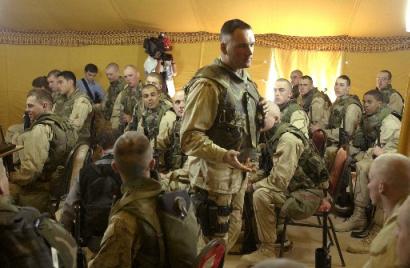
Aside from his current work in Baghdad, Stainbrook, who is a member of the Marines 3rd Civil Affairs Group, reviewed with young American infantry men in early March how to handle specific situations they may face prior to the start of the war.
Inside a tent in the Kuwaiti desert, Stainbrook refreshed the memory of military officers on the art of modern warfare related to civil affairs just weeks before the U.S. declared war. He coached soldiers on what they should do in scenarios like if villagers brought them an injured child or if a humanitarian group asked for help delivering food to hungry Iraqis.
“They’re thinking in their minds, ‘I have to be aware of the enemy,’ which of course is true,” said Stainbrook. “However, we have to minimize civilian casualties and collateral damage.”
Stainbrook has always urged his students to use their common sense in the field such as taking notice of a person who stands out from the rest of the crowd. He also explained to the soldiers on how to best interact with Iraqis, like always asking to speak to the oldest man, never the women, look at them when speaking rather than the interpreter and accept a cup of tea if they offer.
Connie talks to her husband about once every 10 days and he is usually able to talk with her when he’s involved in media interviews with journalists who have mobile phones.
“The last time I talked with him he heard a rumor that he might be coming home in July,” she said. “When I see him on TV, I can tell he’s lost quite a bit of weight. The first and second weeks of the war were pretty stressful. It was hard to pull myself away from CNN.”
Stainbrook has encountered a few dangerous situations including a Humvee accident where the vehicle rolled down a ravine and a shoot-out in Baghdad. Stainbrook has gone from spending four weeks sleeping on the desert ground to now sleeping in a Baghdad hotel room and eating dinner with Bob Arnot, one of MSNBC’s special foreign correspondents.
“He’s gone from one extreme to the other,” added Connie. “It seems as though most people are now getting hurt from accidents, and I think it’s because everyone is tired and they don’t have their wits about them.”
 The Lazy Sway