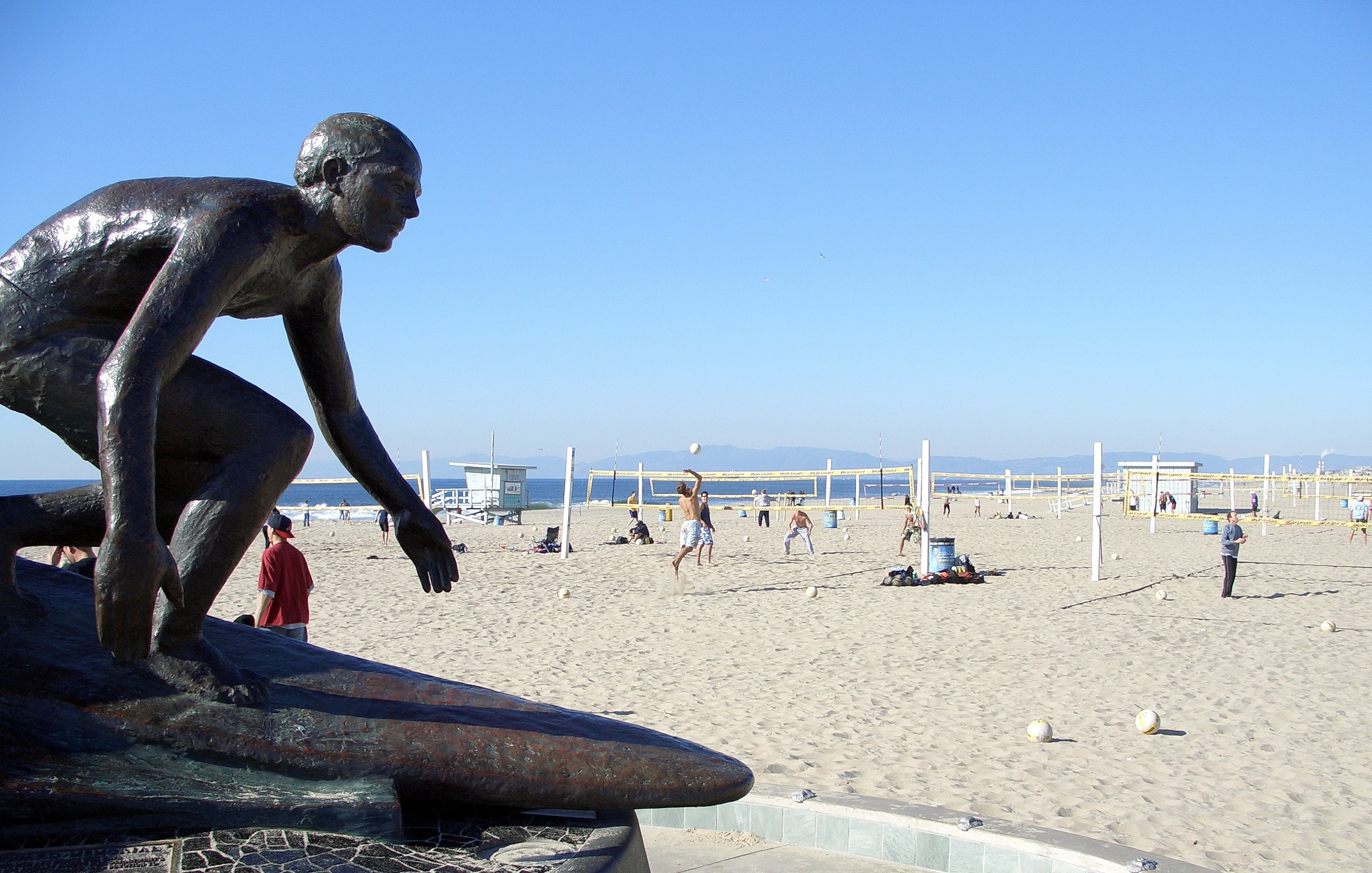
The city of Hermosa Beach this Saturday will pay tribute to a group of individuals who have shaped the city’s rich surfing history by inducting them as the first members of the Surfer’s Walk of Fame.
The Hermosa Beach City Council will induct seven charter members and 16 pioneer members into the walk March 29 during a public ceremony on the pier plaza.
The Walk of Fame is expected to be constructed near the south side of the city’s municipal pier during the third phase of the pier renovation project scheduled to begin later this year.
The question of whom to immortalize was determined by a committee — including the selected members — who are associated with the city’s surfing culture and industry.
The Walk of Fame originated with the vision and fund-raising efforts of Hermosa Beach businessman Roger Bacon.
Since August 1999, Bacon has raised about $40,000. The walk’s several plaques highlighting the charter and pioneer members, along with a surfing introduction and a list of current City Council members, will cost approximately $12,000 per plaque. The individual charter plaques will include the member’s name, signature, surf logo (if applicable) and a brief paragraph explaining how they’ve affected Hermosa’s surfing past and present.
The charter members are Hap Jacobs, Greg Noll, Dale Velzy, Dewey Weber, Mike Purpus, Bing Copeland and Rick Stoner.
Jacobs is a famed surfboard maker who has been in the business since the 1950s.
“In the early 1950s I’d been hanging around Hermosa pier long enough, working the California Surfrider raft rental concession, so I joined the Coast Guard and went to Hawaii,” said Jacobs who began surfing in 1946.
In 1953, Jacobs partnered with Velzy and opened up a surf shop in Venice. The two ended their business partnership in 1960 and Jacobs formed Jacobs Surfboards in Hermosa Beach. At one point, he was making 125 boards a day. Jacobs’ logo was featured in the surfing film “Endless Summer.” He now lives in Palos Verdes and still works in Hermosa Beach.
Velzy, 75, was born and raised in Hermosa Beach. He began surfing at the age of 9 and first started riding the heavy redwood boards which were the most modern at the time.
“I thought to myself, there has got to be a better way to do this,” he recalled. “So, I used my ability to redesign boards with the (lighter) balsa wood.”
Velzy owned a shop near the Manhattan Beach pier. During World War II, he served in the Merchant Marines stationed in the South Pacific. He would spend his vacation time island-hopping. He now lives in San Clemente, and sells his own surfboards with Rip Curl and with the local Spyder Surfboards in Hermosa Beach. He also has a beach named after him in Hawaii called “Velzyland.”
Aside from surfing, Weber was an accomplished yo-yo champion. At the age of 14, he was already a three-time national Duncan Yo-Yo champion. Weber was also a three-time CIF wrestling champion at Mira Costa High School. He later became an all-state wrestler at El Camino College and later qualified for the 1960 Olympic Games in Rome, but was cut from the team after suffering a dislocated elbow.
In 1956, Weber made his first trip to Hawaii and in 1961, formed an amateur surf team of more than 30 members.
Weber was one of the first inductees into the International Surfing Hall of Fame in 1966.
Weber’s wife, Caroline, will be present at the ceremony in honor of her late husband who died in 1993.
Noll is considered to be one of the bravest and best big-wave riders in surfing history. His fellow surfing buddies coined the nickname “The Bull” for his aggressive and no-nonsense approach to the sport.
Noll grew up in Hermosa Beach next to neighbors like Hop Swarts and Leroy Grannis. He started surfing in 1948 at the age of 11 and learned to shape the balsa wood boards in the early 1950s from Velzy.
Noll trekked to Hawaii for the first time in 1954, and he was one of the first surfers to ride the monstrous waves at Waimea Bay and Outside Pipeline on Oahu’s North Shore. In 1969, he rode waves following a fierce storm, some as high as 50 feet. In 1964, he was credited with riding the largest wave ever ridden at Waimea Bay.
“I just wanted to ride a bigger wave than anybody,” he said. “I wanted to do something none of the other guys could do.”
Purpus grew up in the Hermosa Valley section and began surfing at the age of 10 in 1958. His dad bought the house for $5,000. At the age of 14, he joined the Hap Jacobs surf team and Jacobs designed Purpus his very own model when he was 19.
“Hap has been a huge influence on my life; he’s just a fantastic guy,” said Purpus.
Purpus reigned as U.S. Surfing Champion from 1969 through 1974 and toured the world surfing in the pro circuit. He surfed Jeffrey’s Bay in South Africa when the population was less than 50 and traveled to Hawaii for 15 consecutive years where he surfed North Shore’s Pipeline. He remembers Pipeline when surfers didn’t have leashes attached to their boards and lifeguards never rode around on jet skis.
“I remember paddling out three-fourths of a mile to catch a wave and if you lost your board it was up to you to get back to shore; otherwise everyone waved goodbye as you disappeared into the horizon,” he recalled.
Purpus now lives in Redondo Beach, only steps away from the beach. Although he does own a computer, he’s free of the modern amenities like an Internet connection, a phone and a car.
“I’m really honored the city of Hermosa Beach has chosen to recognize me,” said Purpus. “Wherever I was in the world, no matter how good the waves or how pretty the girls, it was always nice to come back to the South Bay that has a little bit of everything.”
Stoner and Copeland first started making boards together in 1959 in Hermosa Beach where they owned a shop on The Strand. In 1958, the duo traveled to Hawaii, Tahiti and New Zealand where they traveled to the Piha Surf Club and were a sensation among the natives.
Club members were a bit skeptical about their new boards shaped of insulated polystyrene covered with resin and chopped strand fiberglass. They were far lighter than the few earlier paddle boards being used in New Zealand. After the two men rode with the boards, club members asked to try them out.
Stoner and Copeland started making boards for club members and built two for the 1959 National Surf Lifesaving Championships which were held in New Plymouth, New Zealand.
Stoner and Copeland each opened up their own surfboard shops in the early 1960s. Stoner later became a Los Angeles County lifeguard and shaped paddle boards for his employers. Stoner’s sons, Jeff and Mike Stoner, will attend the ceremony in honor of their father who died in 1977. Jeff took over the family business and now shapes some surfboards, but mostly paddle boards under his father’s name and logo.
“I think it’s great that not just my dad but all of these guys are being recognized,” said Jeff. “These men are the pioneers of the modern surfboard and it’s great they are being honored not just among surfers but by the community.
“Hermosa Beach was a part of a revolution and if it wasn’t for these guys, we might be hanging out on the volleyball courts instead of out in the water surfing.”
Some 16 pioneer members include Doc Ball, Hop Swarts, Leroy Grannis, Ward Baker, Paul Mathies, Bob Bacon, Ted Kerwin and Jim Kerwin.
The Surfer’s Walk of Fame dedication ceremony is scheduled for Saturday, March 29, at 11 a.m. near the Hermosa Beach pier. For more information, call the city’s Community Resources Department at 318-0247.
 The Lazy Sway