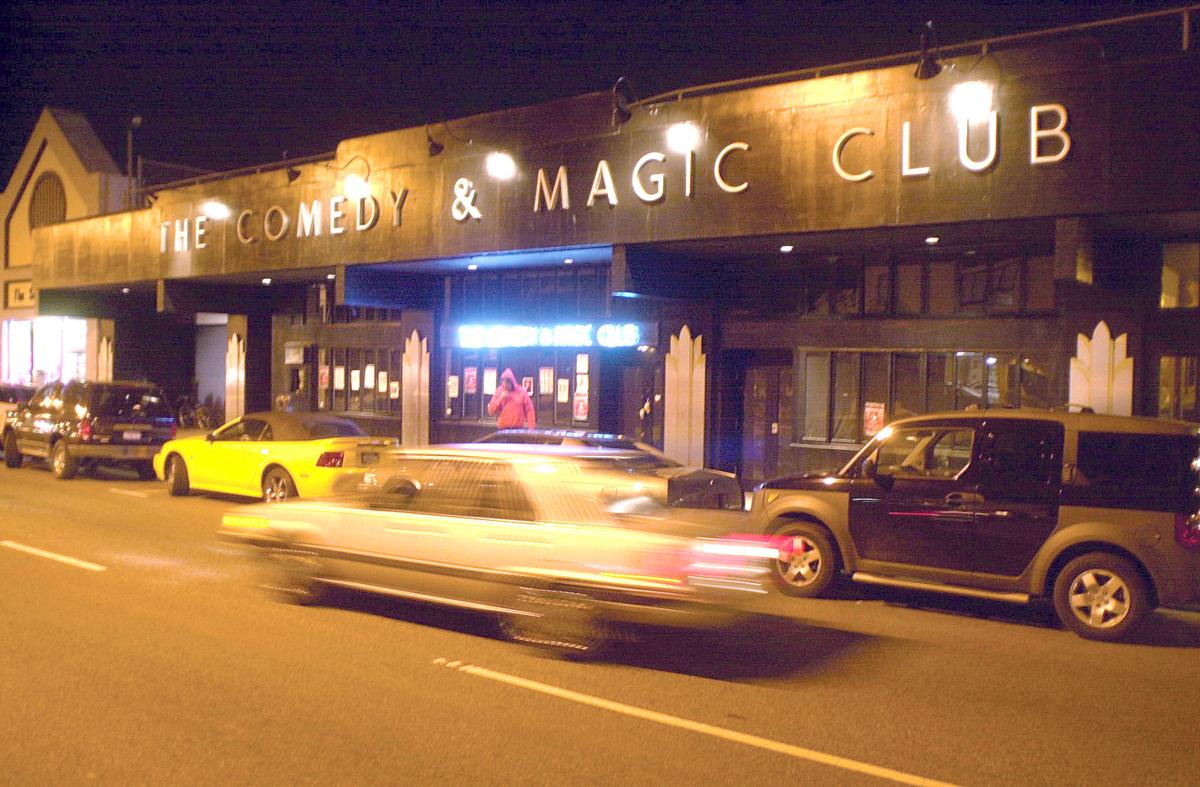
Comedy and Magic Club owner Mike Lacey and the city of Hermosa Beach last Thursday settled on a provisional pact to allow Lacey to gradually reinstate his occupancy to 252 seats based on the state’s building codes through a relatively pain-free process at the local level.
“Mike will be able to get the capacity he needs in two stages,” said Councilman Art Yoon. “There were some legitimate safety concerns which our fire chief expressed and Mike agreed to that will get him additional seating in the short-term. Long-term, there will have to be some design changes, also agreed to by Mike, which will get him the capacity to be profitable. All those changes will be expedited through the process, recorded and set in stone.”
The matter recently came to the forefront after Lacey spoke at a City Council meeting in early February, and later met with Yoon and Mayor Sam Edgerton along with numerous city employees, in a somewhat public meeting in mid-February. Both parties agreed to the meeting Feb. 27 with the hopes of resolving the matter. Lacey’s ongoing discord with the city spans close to three years costing him thousands of dollars.
“I am happy to see this finally move forward but I’m not happy it took so long for the city to finally pay attention to it,” said Lacey.
One issue is whether the city reneged on the occupant load of 252 it once gave to the club in the 1980s through 1996 and whether a new measurement along with a new calculation of the club actually occurred in 1997.
Another topic of debate is how the city interprets the state’s Uniform Building Code related to the definitions of drinking and dining establishments as opposed to theaters.
During the last meeting, Edgerton requested the city look into the code’s regulations regarding aisle width, and how many aisles are located in drinking and dining establishments and in theaters.
The city claims the 252-occupancy load is based on information from the club existing in the 1980s. Lacey’s last remodel of the club occurred in 1994 and the city said it re-evaluated the occupancy loads of all downtown businesses in 1997 by physically measuring each space.
During this time, the city said it calculated the club’s load at 171-plus and added another 10 percent increase to the amount permitted by former Fire Chief Pete Bonano for a total of 188. The city claims this new calculation was made in 1997.
City employees said they informed Lacey his occupant load was 252 in 1996 but later changed the load to 188 after measuring all downtown businesses the following year.
“I don’t think there is any question that mistakes were made,” added Yoon. “However, I think it is wrong to characterize that the mistakes were one-sided. There is plenty of blame and misunderstanding to go around but I’ve never been interested in ascribing blame. Rather I like to look forward and work toward solutions. Our city should be proud of how our senior staff and our mayor worked to keep the club in town. Hopefully, we will be able to move on and stop any destructive rhetoric or calls for unreasonable actions by either side.”
In both an interoffice memorandum drafted by Senior Building Inspector Charlie Schwartz to several city employees and a letter sent to Lacey from Community Development Director Sol Blumenfeld dated in September and October of 1996, respectively, the city established an allowable occupant load of 252 for the club based on state codes by defining the club as a drinking and dining establishment.
“The figures are calculated using the square footage of the particular tavern multiplied by the allowable occupant load factor provided by the Uniform Building Code,” states Schwartz. “Figures provided have been derived from approved building plans, visiting and measuring the building or existing city records. Every effort has been made to insure accuracy and completeness…”
A theater would allow for a higher occupancy. The city submitted the inquiry to the International Conference of Building Officials. According to state codes, one person per 15 square feet calculates dining and drinking areas whereas spaces like dance floors and theaters are calculated using a one person per 7-square-foot ratio.
According to state codes, a theater is required to have approximately 44 inches of free space constituting aisles. Lacey has told city officials he has lost upward of $22,000 in revenues in one month. He has also spent approximately $50,000 on the services of various architects. He spent funds earmarked for the purchase of a new parking lot for his patrons, hoping to resolve the issue with the city.
The club has been in Hermosa Beach since 1978 and was one of the first clubs to pay comedians. Comedians such as Dave Letterman and Jerry Seinfeld first started out in the club. Today, comedians such as Jay Leno, Ray Romano, Gary Shandling, Howie Mandel and George Wallace are regular acts at the club.
Letterman and George Carlin both came through the club in the early days and comedians like Paul Reiser, Jim Carrey, Tim Allen, Billy Crystal, Rodney Dangerfield, Dana Carvey and Dennis Miller have made guest appearances.
 The Lazy Sway