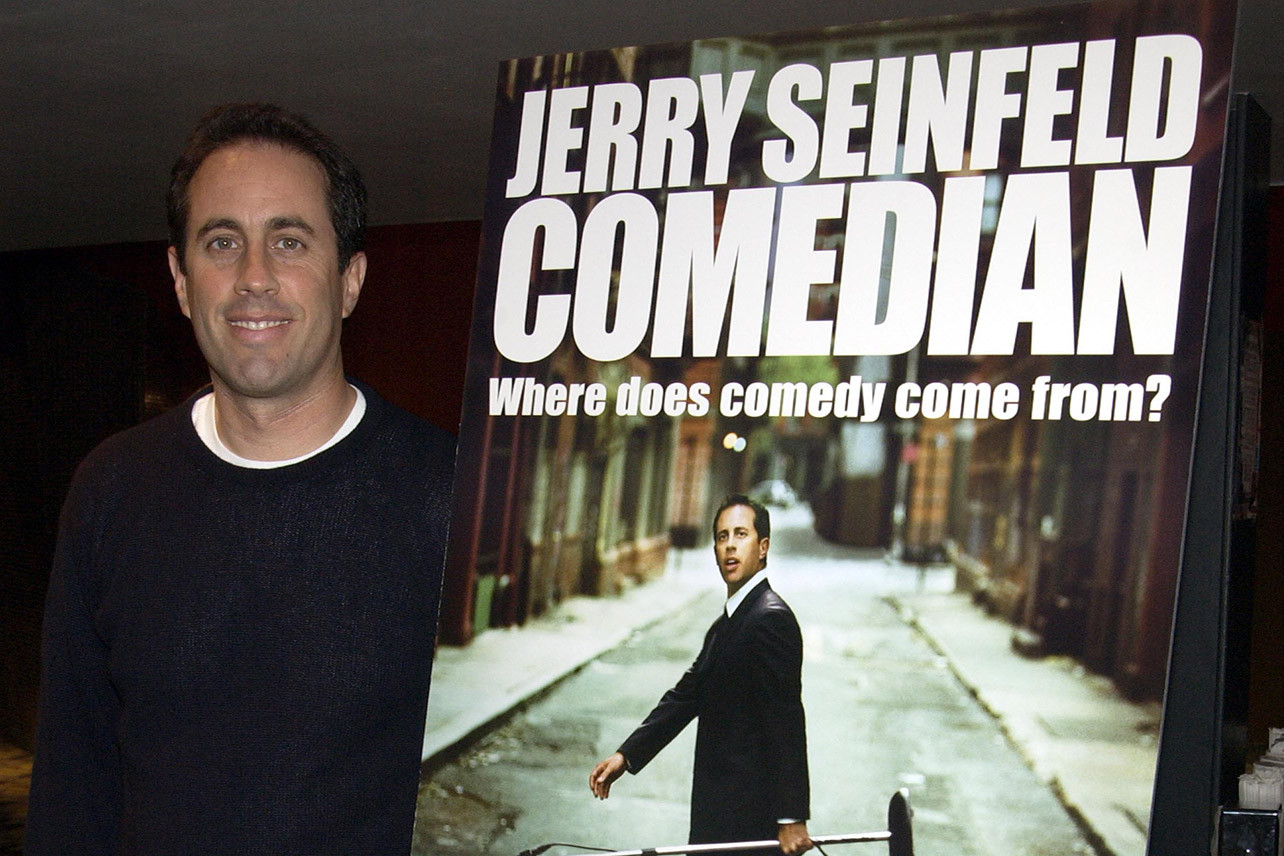
In the film “Comedian” released last year, actor and comedian Jerry Seinfeld provides a backstage pass into the challenging world of stand-up comedy.
Seinfeld, who by extension represents every other famous comedian, offers an engaging look into the struggles of etching out a comedic niche while reminiscing about the birth of the colorful art form.
Director Christian Charles follows Seinfeld from one club to the next with two hand-held cameras for more than a year.
Seinfeld shares his self-doubts and accepts the suggestions of fellow colleagues Jay Leno, Gary Shandling, Chris Rock and Bill Cosby in putting together an act with more than 60 minutes of new material.
In the film, Seinfeld talks candidly about the best night in the history of stand-up comedy. It was a night when he appeared at the Comedy and Magic Club in Hermosa Beach and brought a few of his friends with him.
“Saturday Night Live” star Kevin Nealon was the master of ceremonies during this historic night, and introduced Chris Rock and Gary Shandling who were the two opening acts. Seinfeld finished the show as the headliner.
“I remember Jerry sitting in my office at the absolute height of his career and telling me it was the best performance in the history of comedy,” remembers Lacey.
At that time, Lacey had no idea what the night had in store, but it was one he’ll always remember on a professional and personal level.
That night, his aunt and uncle came down to the club for dinner. His uncle who was diagnosed with brain cancer was feeling fairly good that day and decided to visit Lacey.
Seinfeld called Lacey and asked if he could have the entire second set to himself and Lacey agreed.
Lacey’s uncle — who was once a professional baseball player, a World War II hero and a stunt man in the movies — felt well enough on that night to stay for the second act.
It was the last show Lacey’s uncle ever saw and that show is featured in “Comedian.”
Ever since its opening in 1978, the Comedy and Magic Club has become famous for hosting both scheduled gigs and unexpected visits from some of the most talented comedians including Dave Letterman, Tim Allen, George Carlin, Jay Leno, Ray Romano, Robin Williams, Dennis Miller, Rodney Dangerfield, Billy Crystal, Dana Carvey, Jim Carrey, Gallagher, Paul Reiser and George Wallace.
I followed Lacey on a Sunday night when Leno was the headliner, and Jim Edwards and Jim Rogan were the two opening acts.
Lacey works six days a week from 11 a.m. to 9 p.m. weekdays and only at night Saturdays and Sundays.
I’m wearing my Los Angeles Rams thrift store T-shirt and before we do anything, Lacey tries tracking down a Comedy and Magic Club jacket to keep me warm.
“Mr. Lacey wants to know if there’s a jacket in there he could use,” asks the employee at the front desk of the employees sitting in the sound booth. The exchange takes place over a small phone speaker we can all hear.
“Does he need one?” inquires the sound guy.
“It’s for somebody over here in the office,” says the employee.
“Who’s the somebody?” he asks.
We all laugh and Lacey rolls his eyes and smiles as another voice in the sound booth comes over the speaker.
“Yes, we have one for him.”
After only a few minutes I realize this kind of humorous exchange is just one of many funny conversations that take place probably every night between Lacey and his employees.
Lacey usually arrives at the club around 6:30 on Sundays as the first act begins at 7 p.m. The venue teems with an energy comparable to the moments before a music concert begins except I’m backstage instead of out on the floor.
Lacey’s first task is to walk over to the Beach House at Hermosa and book a room for comedian John Pinette who is scheduled to appear later in the week.
The concierge looks stressed out as he frantically talks on the phone while punching information in the computer. A fellow co-worker called in sick and he’s had to man the front desk alone.
After listening for a few moments, Lacey knows he’s talking to the manager and asks to talk to him when he’s finished.
Looking somewhat terrified, the employee hands Lacey the phone, thinking he might complain about the service. He relaxes once Lacey begins having a chat with the person on the other end who is clearly a friend. He eventually completes the transaction with the customer being helped prior to our arrival.
The employee eventually books a room for Pinette, and tells the valet driver he’s starving and hasn’t had a chance to eat dinner.
“What do you want? I’ll have someone at the club deliver you some food,” asks Lacey. “We got fish, chicken, steak, pasta, you name it.”
“No, you don’t have to do that,” says the concierge.
“No, please get something, I know what it’s like to work full shifts,” he replies. “I used to work double shifts at a gas station.”
Both the valet and the concierge order pasta. Lacey then walks swiftly back in order to meet Leno outside the club at 7 p.m.
On the way back Lacey briefly describes how the guy who studied auto mechanics in college is now the owner of a successful comedy club.
“My uncle, who was a playwright, wrote ‘The Music Man’ and never had to work again. He got me involved in the business,” explains Lacey.
Lacey’s uncle was best friends with famed writer Aldous Huxley (“Brave New World”). Lacey’s aunt and uncle never had any children and so they spent time with Lacey, taking him to plays and musicals three to four nights a week when he was a teen-ager.
“My uncle had plays just sitting around in his closet and since I was dyslexic and could barely read or write, I thought of producing these plays,” recalls Lacey.
Lacey enlisted the expertise of Karen Wood, a graduate in theater arts from UCLA. Wood taught Lacey the fundamentals of how to produce a play. Lacey, who was in his early 20s at this time, knew it would cost a great deal of money to produce a play and so he turned to his friend Robin Williams to “punch it up.”
Lacey became exposed to and fascinated with the world of stand-up comedy, and decided he liked it better. At the age of 24, Lacey built the club and opened it two months after his 25th birthday.
On our walk back to the club, Lacey stops on the corner of Hermosa and Pier avenues, pulls out his wallet and grabs a $20 bill.
“You’re probably thinking, ‘How much for me to shut up, right?'”
On the contrary, Lacey, who stands around 6 foot 3, possesses a sense of humor and enthusiasm that brings to mind the age-old saying, “Time flies when you’re having fun.”
He’s everything I’d normally never associate with your stereotypical club owner. He’s endearing, genuine and modest, but most of all he’s grateful for the success he’s had over the years. He’s grateful to book the comedians and serve the audiences he does.
Lacey and I walk into the club’s office door and down a long hallway. We pass a conference room erected out of concrete cinder blocks with the signatures and comments of those comedians who have made their mark in the world of comedy and stopped at the club to do an act or two along the way. Letterman’s autograph is completely worn out because every comedian has rubbed it for good luck before going on stage.
Someone from inside the rooms yells, “Have you gotten any pictures of Mike without his shirt yet? Make sure you do.”
We walk through the kitchen where Lacey puts in the order for the two hotel employees and we then walk into the actual club. It’s full of people eating, drinking and awaiting the first act beginning at 7 p.m.
“This is what I’m most proud of,” says Lacey as he scans the crowd. “The audience. We have every single age group represented here. We have people in their 20s and we have people in their 80s. I love being able to stand at the front and watch the reactions of my customers.”
We then make our way outside to meet Leno, who pulls up in a red 1969 Lamborghini. Lacey shakes hands with Leno, and they both walk back into the club and toward the conference room.
Leno spends part of his time meeting with Lacey and eating dinner. Leno welcomes me inside and he encourages me to eat something from a small buffet of food which includes a plate of chicken wings, pasta with marinara sauce, steak and a plate of watermelon. He, of course, didn’t eat it all.
What does one ask the guy whose job is to ask all of the questions? He tells me he enjoys coming down to Hermosa Beach to test out his “Tonight Show” jokes on an audience he feels is more representative than those watching the television show. Leno has been coming down to the club since it opened.
“It’s a great area,” he says. “The audience here is more reasonable in terms of how they respond to jokes. When I do my act in Hollywood the crowd is mostly all industry people and so they get the inside jokes about the industry and people working in the industry where if I made a joke about William Morris (talent agency) here, they’d probably think I was talking about a tobacco company. The crowd here is more indicative of what will work in the real world.”
Leno was funny. He had a kind of humor you almost never see or hear on NBC and in that humor is where his best jokes of the night came from.
Following Leno’s last word, Lacey waits outside to say goodbye. The doormen hold the crowd for a moment while Leno leaves. Getting him out of the club and into his car has a rehearsed premeditation to it, and the first analogy which comes to mind is when Secret Service agents escort the president out of a crowded building.
“We try and get him out fast because people are star-struck. We have patrons walking out into the middle of the street to meet him and they block traffic in the process,” explains Lacey.
He stands outside and talks with many of his patrons. At the end of the night, he finishes up a few loose ends and always leaves just in time to catch a 10 o’clock movie.
 The Lazy Sway