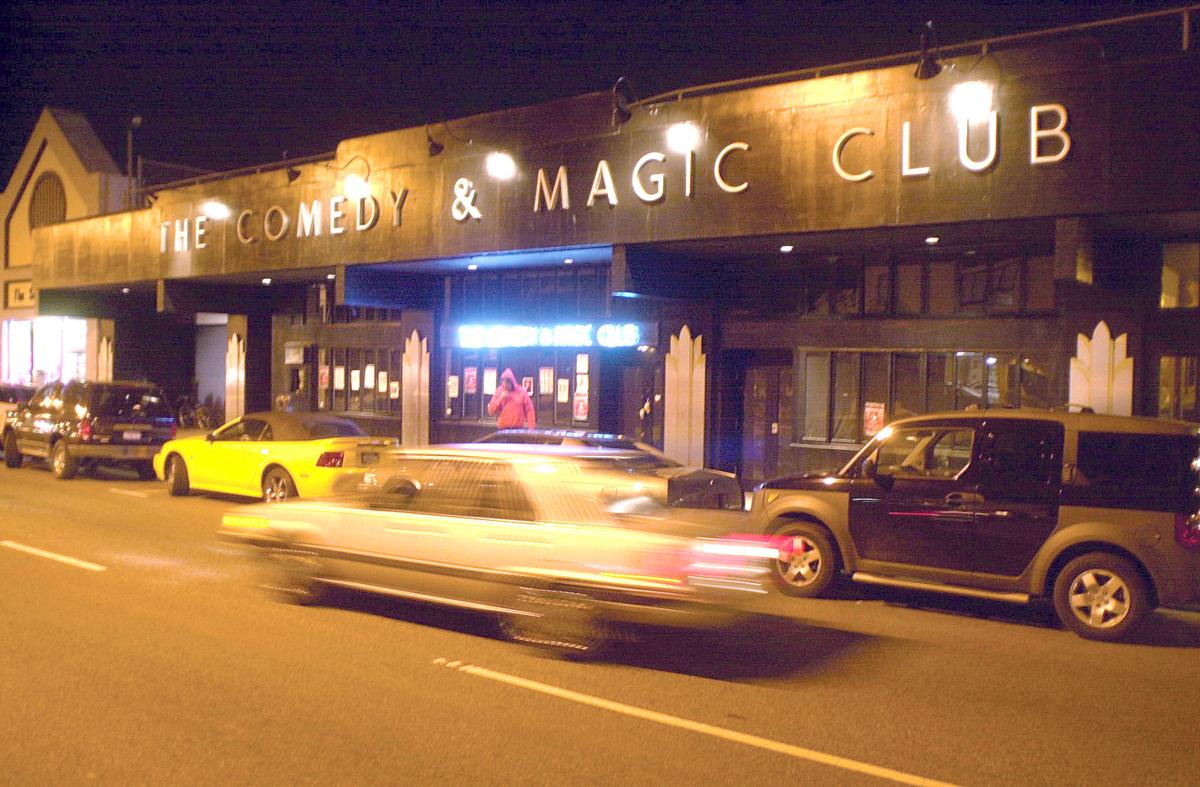
Hermosa Beach city officials Sunday afternoon discussed various issues related to a recent and ongoing discord with local business owner Mike Lacey regarding the occupancy load of his establishment, the Comedy and Magic Club.
More than 30 people interested in the matter attended the public meeting hosted by Mayor Sam Edgerton and held at The Lounge, a bar connected to the club also owned by Lacey.
The matter recently came to the forefront after Lacey spoke at the last City Council meeting. His feud with the city spans more than two years, costing him thousands of dollars.
Those attending the meeting included City Manager Steve Burrell, Senior Building Inspector Charlie Schwartz, Councilman Art Yoon, Chamber of Commerce members, Fire Chief Russell Tingley, Planning Commissioner Peter Tucker and Community Development Director Sol Blumenfeld.
One issue is whether the city is reneging on an occupant load of 252 it once gave to the club in the 1980s through 1996 and whether a new measurement along with a new calculation of the club actually occurred in 1997.
“First, let’s make a distinction. City Council and city staff are not always on the same page. Right now, city staff is taking a different approach than I would but I would also back off from making any directives yet as I am no expert on building codes,” said Yoon. “The staff argues the use of the Comedy and Magic Club is along the lines of a drinking and dining establishment. This is based upon some correspondences with the ICBO (International Conference of Building Officials) and West Hollywood which is replete with similar establishments. But all those correspondences couch their remarks as only advisory and seem to give latitude to the cities to make interpretations. If there is room (no pun intended) to make a broad interpretation in favor of the club, then I look forward to making the finding favoring it.”
Another topic of debate is how the city interprets the state’s Uniform Building Code related to the definitions of drinking and dining establishments as opposed to theaters. The city will now look into the code’s regulations regarding aisle width, and how many aisles are located in drinking and dining establishments and in theaters.
The city claims the 252-occupancy load is based on information from the club existing in the 1980s. Lacey’s last remodel of the club occurred in 1994 and the city said it re-evaluated the occupancy loads of all downtown businesses in 1997 by physically measuring each space.
“Without a doubt, there was an error in either the math or the factor in which the club was calculated,” said Tingley. “Through our internal investigation, it is my belief that 252 was the number before the Lounge (Igor’s) wall was moved north (making the club smaller) and that it didn’t get corrected until sometime later leaving some to believe that 252 was a good number for even the smaller club,” said Tingley. “The city never adjusted the number at that time by remeasuring the new remodel. It just reviewed existing information in the file at that time.”
During this time, the city said it calculated the club’s load at 171 plus and added another 10 percent increase to the amount permitted by former Fire Chief Pete Bonano for a total of 188. The city claims this new calculation was made in 1997.
City employees said they informed Lacey his occupant load was 252 in 1996 but later changed the load to 188 after measuring all downtown businesses the following year.
“If the Fire Department did come down to measure my club in 1997, don’t you think there would be some kind of correspondence in the Fire Department’s file on the club noting its correction from 252 to 188?” inquired Lacey. “Don’t you think the city would have sent me a letter informing me of this correction? There was not one document in the city’s file stating its new measurements to get its new lower number nor did the city ever send me any letter telling me about this new occupancy. I received nothing and there’s nothing in the file because it never happened. The city is making things up that just aren’t true.”
Lacey contends the city has progressively decreased his occupancy load despite his renovations expanding the club. He initially had a load of 353 in 1978, the year the club first opened, to 316 in 1986 to 291 in the early 1990s to 252 in 1996. Lacey said a calculation of the club’s latest load of 252 incorporated every physical remodel of the club with the last one being in 1994. Lacey also claims the city never measured his business in 1997 to reach the 188 amount as it said it did.
In both an interoffice memorandum drafted by Schwartz to several city employees and a letter sent to Lacey from Blumenfeld dated in September and October of 1996, respectively, the city establishes an allowable occupant load of 252 for the club based on state codes by defining the club as a drinking and dining establishment.
“The figures are calculated using the square footage of the particular tavern multiplied by the allowable occupant load factor provided by the Uniform Building Code,” stated Schwartz. “Figures provided have been derived from approved building plans, visiting and measuring the building, or existing city records. Every effort has been made to insure accuracy and completeness…”
In March of 2000, the city’s fire chief, Tingley, issued new placards for every downtown business reconfirming their new occupant load. According to Tingley, the process of measuring and calculating new occupant loads of every downtown business was conducted by his predecessors which ended shortly before the city appointed him as the new chief.
“I did send out the new occupancy signage to the downtown businesses but I arrived just about the time the calculations of the new occupancy loads were being completed,” said Tingley. “The former fire chief and the building inspector went around to every business and measured every single place so that everyone was treated fairly based on the actual measurements of the business. It was a collaborative effort. Usually building departments determine the occupancy loads and fire departments are there to enforce it.”
Although the city calculated the new occupant load in 1997, it waited until 2000 to send the businesses their new occupant signs of their new loads.
According to city documents, Lacey began submitting alternative plans in order to maintain his 252-occupant load and the city approved several plans including one that would have allowed him to have an occupancy rate of 320 if he decided to move forward with a new remodel.
Last May, Lacey’s architect inquired to the city to see if his club could fall under another use other than a dining and drinking establishment such as a theater.
A theater would allow for a higher occupancy. The city submitted the inquiry to the ICBO. According to state codes, one person per 15 square feet calculates dining and drinking areas whereas spaces like dance floors and theaters are calculated using a one-person-per-7-square-foot ratio.
“It does not fit my definition of a theater,” added Tingley. “There is much more to occupancy than the use. It doesn’t just stop at use. It’s also dependent on the furniture and whether it’s fixed or not, and if the business is providing enough aisle space for exits. Theaters have better numbers because everything is fixed with adequate aisles and aisle width between seats. Places like the House of Blues in Hollywood use a 1-to-15 factor even though some may think of it as a theater. It has a dining area with tables where food is being served and so less people are able to fit inside compared to an auditorium or a movie theater.”
The ICBO responded to the city by saying it is justified in considering the club an auditorium with a one-to-seven factor if there is fixed seating around the edges. The ICBO would also classify a club where the dining is limited and the remaining use operates as a theater as a live theater with dining. The dining layout is used to determine the occupancy, and would remain in place before and during theater performances.
“This business is all about the number of seats and it’s all about capacity,” said Lacey. “I sell tickets so I don’t have to rely on the sales of liquor or food. It’s a theater and I’m losing thousands of dollars every month because I can’t sell as many tickets. I also can’t reduce the salary of the entertainers and I can’t pay less in insurance. It’s like the city coming into your house you’ve owned for ages and asking to see your plans. They then tell you they no longer agree with the city’s forefathers and tell you your home is calculated in the wrong way and has been for a long time. They then force you to move into an expensive apartment and then drag you through a terrible process that makes no sense, lasts for two years, and in the end force you to remodel your house and you have to pay for the whole thing.”
Last July, the city enlisted the opinion of an independent analysis conducted by James Franklin, a principal fire and life safety specialist with Hayer Consultants Inc. In a letter addressed to Blumenfeld, Franklin stated the occupant load for the club should be at 161 based on 2,406 square feet divided by the load factor of 15 square feet per person.
“With a theater standing you get the seven which is at least 252 but with a restaurant standing you get 15 and when you add 10 percent, you get 188,” said Edgerton. “The issue is whether you can have a theater without having fixed seating. From the city’s side, it can’t say it doesn’t consider it a theater because it initially used the 7-to-1 ratio. It couldn’t explain why it used this factor. All it could explain was why it now used the 15 ratio.”
According to state codes, a theater is required to have approximately 44 inches of free space constituting aisles. The city will now take a closer look at whether the code requires a certain amount of free space in between tables and chairs throughout an entire establishment. The code also requires a certain number of exits and adequate walkways to such exits.
“If you don’t need that 44 inches in between tables and chairs, then it looks as though Lacey may get this,” added Edgerton. “If not, the city needs to explain why it needs to be this way with concrete proof. The city changed the multiplier in 1999, but Lacey has a letter from 1996 with the 252 load. He’s angry and after evaluating all the facts, I see his point.”
Lacey has lost upward of $22,000 in revenues in one month. He has also spent approximately $50,000 on the services of various architects. He spent funds earmarked for the purchase of a new parking lot hoping to resolve the issue with the city.
The club has been in Hermosa Beach since 1978 and was one of the first clubs to pay entertainers. Comedians such as Dave Letterman and Jerry Seinfeld first started out in the club. Today, comedians such as Jay Leno, Ray Romano, Gary Shandling, Howie Mandel and George Wallace are regular acts at the club.
Letterman and George Carlin both came through the club in the early days and comedians like Paul Reiser, Jim Carrey, Tim Allen, Billy Crystal, Rodney Dangerfield, Dana Carvey and Dennis Miller have made guest appearances.
Lacey has also received offers from nearby cities that are trying to persuade him to relocate his business.
Edgerton will host a second meeting Feb. 19 at 7 p.m. at The Lounge adjacent to the Comedy and Magic Club.
 The Lazy Sway