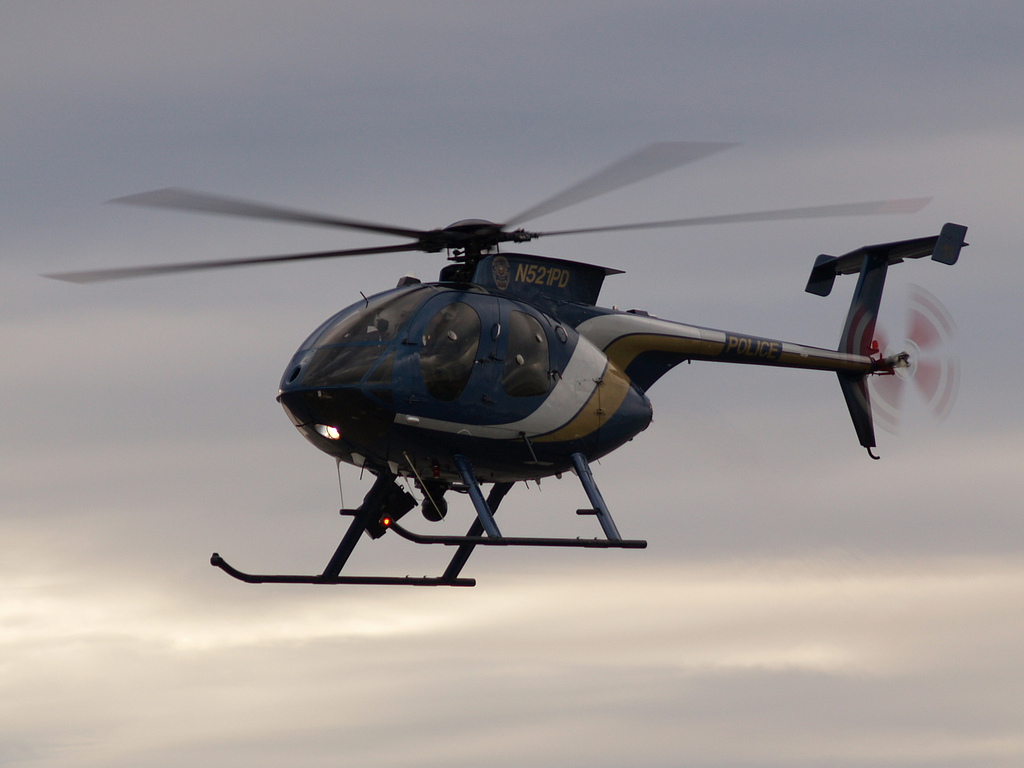
If you’re either a resident or visitor in Hermosa Beach, there are some nights, particularly on the weekends, when you can’t help but hear the sounds of a helicopter flying overhead in quiet neighborhoods.
In recent months, some residents have complained about the noise to police, inquiring as to whom is piloting the helicopter and why it is flying in Hermosa Beach.
According to Hermosa Beach Police Chief Mike Lavin, the helicopter flying in town, mostly at night, belongs to the Hawthorne Police Department. Over the holidays, the Hawthorne Police Department used the helicopter to track drunk drivers from the air in conjunction with the South Bay Regional DUI Task Force program.
“The department uses the helicopter to spot vehicles and coordinate units for the DUI checkpoints that have been coordinated every night for the past two weeks,” said Lavin. “It’s a pretty successful addition by Hawthorne Police to all of the South Bay agencies participating. It usually doesn’t fly here other than supporting the task force. We usually don’t have helicopters here unless we report a specific incident where we need one.”
The Hawthorne Police four-seat helicopter is an MD 500 E model that flies at about 140 mph, and is equipped with a night-sun search light; FLIR (Forward Looking Infrared), which sees people glowing in the dark from their body heat; and a LoJack system to track stolen cars. The helicopter also uses a map system that works off a global positioning satellite.
“The helicopter flies in conjunction with the South Bay DUI Task Force over the holidays. Departments were specially involved in drunk driving enforcement with the helicopter through a program that was funded by the Office of Traffic Safety out of Sacramento,” said Hawthorne Police Lt. Paul Moreau, who runs the air unit. “The state gave us a grant to go out and put a dent in drunk driving which is what we were doing out there.”
According to Moreau, the task force used the helicopter for a period of 10 days over the holiday season that began Dec. 19, ended Christmas Eve, began again Dec. 27 and ended on New Year’s Eve. Over the holidays, officers from South Bay police departments such as Manhattan Beach, El Segundo, Redondo Beach, Hermosa Beach, Torrance and Gardena set up numerous sobriety checkpoints throughout the area.
“Over the holidays, the program had police vehicles from all the South Bay cities working the field and then it also had the helicopter in the air. It’s very easy to spot impaired driving from the air,” added Moreau.
Hawthorne Police Sgt. Keith Kauffman wrote the grant for the DUI program and the department received $135,000 to be used for gas, salaries, maintenance and insurance to crack down on drunk driving for the next 18 months.
“You can see people driving without their headlights on or bobbing and weaving or speeding or missing the limit line,” added Moreau. “It’s still less expensive when doing it with the DUI enforcement to use a helicopter than it is to set up a checkpoint which takes about 20 people to run it. We figure we can probably save about $1,000 over the course of an 8-hour period using a helicopter instead of a traditional checkpoint. This is a very unique program in that as far as we know, we are the only police helicopter unit in the entire United States that is doing this – catching drunk drivers from the air – so we are pretty proud of it.”
The task force just completed 10 DUI missions and will complete one a month for the next 11 months and 10 more the next holiday season followed with six months of monthly checkpoints, beginning in early 2005.
“All of the traffic sergeants from each city get together beforehand and plan it out what city will be the impacted city on a particular night. We call it the host city,” said Moreau. “I’m not sure if each city is hit equally over the 10 days. I’m sure Torrance is, being it’s the biggest city and Sepulveda is a very busy street. Manhattan and Hermosa are host cities too, because there are a lot of bars in that area. Hawthorne is also a frequent host city because there are a lot of bars on Inglewood Avenue.”
According to Moreau, other than the DUI task force efforts, the Hawthorne helicopter only makes its way into Hermosa Beach if it’s responding to an emergency mutual aid call or conducting a routine patrol.
“Generally, we don’t fly into a city unless requested but we have flown over the South Bay doing regular law enforcement patrols with it and we’ve had some calls in Hermosa, Redondo, Manhattan and Torrance,” said Moreau. “We’ve been all over with it, and we usually don’t go into a city unless we are called, but we’ll do some patrol flights around schools, parks and the shoreline as a service to our fellow cities.”
Moreau said the Hawthorne Police Department currently employs civilian pilots to fly the helicopter. A tactical flight officer, all of whom are police officers, accompanies the pilot on rides and calls. The helicopter usually flies at about 500 feet but usually increases to 700 feet in areas like the beach cities. The cost to fly the helicopter is estimated at $500 per hour.
“We know that folks in Hermosa and Manhattan are sensitive about noise issues and so we are sensitive to that. However, if there is a call going on down below, the helicopter will drop down and start orbiting around the call because we are there to back the ground officers,” explained Moreau. “For their safety, we will go down as low as we can and we use our searchlight or the FLIR if we are looking for somebody who is hiding from them. We know the folks in the beach cities are sensitive to the noise so we keep it to a minimum as best we can, but sometimes we have to drop down low.”
According to Lavin, with the exception of the DUI checkpoints, the city of Hermosa Beach hasn’t needed to request the use of a helicopter in “quite some time.”
“We would use it if we had a situation where we had someone cornered or surrounded and we were looking for them,” said Lavin. “It’s good to bring in an air unit to coordinate with ground units that have established a perimeter. It’s a very effective tool in spotting anything on the ground; they can locate a suspect in that type of situation. I can’t think of the last incident when we needed one.”
Aside from responding to calls and patrolling the area, the Hawthorne Police Department regularly uses the helicopter to transport people or paperwork from one area to another.
“Sometimes we have had to transport detectives quickly from one place to another like when they are doing search warrants or we’ve had to transport documents that had to make it from one end of the county to another immediately,” said Moreau. “We also go to alarm calls, pursuits and that’s when you really start to see a savings in money. The safety the helicopter provides in a high-risk call such as a pursuit where the ground units that would be traditionally chasing the bad guys as they are busting red lights and driving like an idiot because he wants to get away is really valuable. The ground units can back off and they don’t have to drive through intersections like the bad guys are. They let the helicopter call it out because the guy can’t outrun the helicopter. They’ll stop, crash or bail out of a car and then the helicopter can help direct the ground units to set up a perimeter.”
The Hawthorne Police purchased a helicopter three years ago, which has since been traded in for its existing model. The pilot and the tactical flight officer usually fly around for about an hour and a half, and then touch down at the Hawthorne Airport to stretch and refuel. The Hawthorne helicopter is the only one flying in the South Bay and it is allowed to fly as high or as low as it wants because it’s a police helicopter.
“Since the history of this program, we have had a couple of people who have complained about the noise. I try to call them all back and explain to them what’s been going on and why we were doing what we were doing because we certainly don’t want to make enemies,” said Moreau. “We want everybody to be on our side and know this is a great tool, and we are here to serve the public. However, there are times when it is needed in the beach cities. In one instance, there was a traffic stop on a dark street in Hermosa with no streetlights at all, and the cop was a one-man unit. He’s making a stop at two in the morning so the helicopter went down low, lit him up and stayed there until a backup unit arrived. It’s for the officer’s safety. Things do happen in the beach cities not as much as in some other areas, but cops get killed in beach cities just like they do in L.A.”
 The Lazy Sway