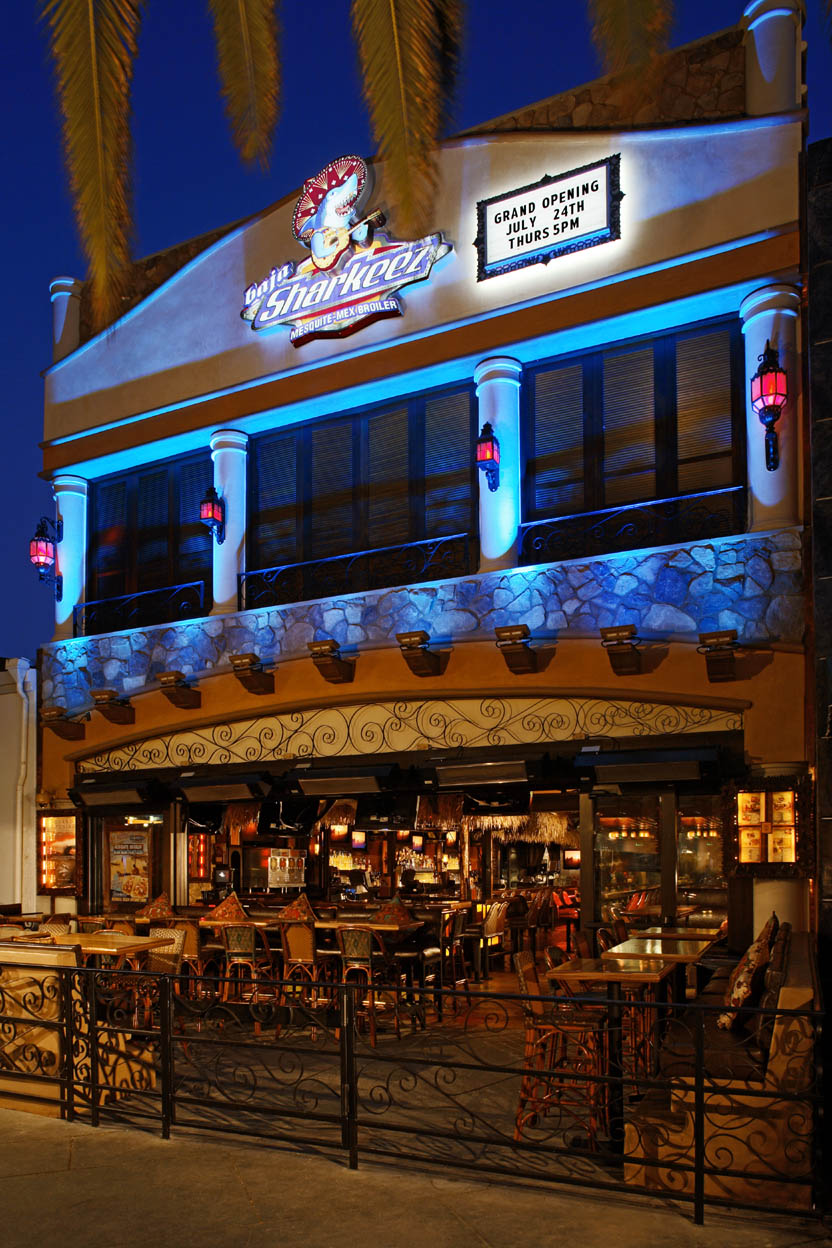
City officials and a downtown Hermosa Beach business are at odds over the city’s recent attempt to enforce a lower occupancy limit.
The dispute started after the city asked Aloha Sharkeez to submit an application to amend its conditional use permit to allow for a higher occupancy, citing that the occupancy levels the business currently uses are illegal. The city stakes its case on the fact that Sharkeez is defined as a restaurant in its CUP.
Sharkeez owner Ron Newman, however, contends that his business is a bar, and that the occupants of his building have been bars for the past 30 years. He says his approved dance floor allows him a higher occupancy. He also claims that the issue over whether his business is a restaurant or a bar is moot because the city doesn’t base occupancy on its CUPs.
According to Sharkeez’s lawyer Rick Warren, the city codes allow for two occupancy levels at Aloha Sharkeez based on its dance floor use. The codes define dance floors as spaces of concentrated use without fixed seating. Dining and drinking areas call for less concentrated use.
“The city itself has stated that the capacity of Sharkeez is not determined by any CUP,” explained Warren. “Therefore, it makes no sense that the city continues to justify its lower capacity by relying on this purported CUP that requires Sharkeez to operate as a restaurant.”
During the day, Sharkeez employees place tables and chairs on the dance floor, thus lowering the occupancy to 172. In the evening after the kitchen closes, the tables and chairs are removed, allowing for a higher occupancy of 205.
Community Development Director Sol Blumenfeld has calculated an occupancy of 111 based on Sharkeez’s restaurant CUP. He said that because the city views Sharkeez as a restaurant, it must always adhere to that occupancy at all times.
Newman said he has offered to lower his evening occupancy to about 170 in the hopes of reaching a compromise with the city.
“How can the city ask businesses to abide by the law if it is not?” said Newman. “I have another Aloha Sharkeez in Manhattan Beach and the city has been more than fair with its enforcement because it operates by the book.”
Three Hermosa Beach City Council members recently discussed the matter in a closed session meeting with City Attorney Mike Jenkins and City Manager Stephen Burrell. Councilmen Sam Edgerton and Art Yoon agreed with Newman while Councilman J.R. Reviczky thought the city was justified in its enforcement.
“This property has a restaurant CUP (dating back to previous tenant Pier 52). It just didn’t function as a restaurant and so it was always out of compliance,” explained Reviczky. “If Sharkeez wants to be a bar they should say it and we should say it. Let’s call a spade a spade. I do agree that Pier 52 was a bar, but it was a bar out of compliance. Does this allow for Sharkeez to be out of compliance too?”
Reviczky said conditional use permits provide cities with the power to mitigate any potential problems. CUPs have been established by many cities to enforce city ordinances that the state Alcoholic Beverage Control does not address.
As with any Hermosa Beach business, the occupancy level of a restaurant or bar is always determined by the use of space.
“Occupant load is not determined by conditional use permits,” explained Blumenfeld. “However, there is a CUP in effect for this restaurant which establishes the legal operation of a restaurant and has bearing upon how the restaurant is occupied and the calculation of occupant load. He (Newman) currently has a CUP for a bona fide restaurant with on-sale alcohol under a resolution issued in 1968.”
“The city is moving away from the uniform building count by not giving credit to Ron’s approved dance floor,” said Edgerton. “This issue has nothing to do with alcohol use or restaurant use. Ron has an approved 233-square-foot dance floor; he is not asking for anything he doesn’t already have. The city is driving him the other way. Does the city really want another Pier 52?”
Both sides are basing their arguments on the property’s complicated history. In 1968, the city changed the property’s CUP in order to allow the business to serve alcohol in conjunction with a restaurant. Over the years, the property functioned as a bar. Newman added a kitchen in 1997.
In 1969, the city declared the CUP null and void because the owner’s request for a different alcohol license had been dropped. In his recent letter to Newman, Blumenfeld argued that because the business had reverted to a restaurant, the CUP was in effect.
“Notwithstanding any illegal business operation, the new owner restored the property to its legally permitted use in 1997 when a full kitchen was installed on the premises,” Blumenfeld wrote. “This change re-established the originally permitted use on the property and the city is compelled to enforce the CUP originally granted for the restaurant in 1968.”
Newman contends that the only CUP associated with Sharkeez is an entertainment permit regarding an approved dance floor.
 The Lazy Sway